
Type 2 + Type 9 Compatibility 💚💜: A Bond Built on Peace and Care
Apr 08, 2026
A relationship between an Enneagram Type 2 and Type 9 is rooted in warmth, harmony, and support. Type 2’s natural generosity and attentiveness blend with Type 9’s calming presence and desire for peace, creating a partnership filled with comfort and stability. While Type 2 brings nurturing energy and heartfelt connection, Type 9 offers steady reassurance and a soothing nature. Together, they cultivate a bond that feels safe, kind, and deeply affirming.
However, challenges arise when Type 2 overextends themselves in the hope of being needed, while Type 9 withdraws or avoids conflict to keep the peace. This can create distance or unspoken tension. The key to a thriving Type 2 + Type 9 relationship is for Type 2 to recognize their worth apart from constant giving, and for Type 9 to engage more directly instead of retreating—so both partners feel seen, valued, and emotionally connected.
But how compatible are Type 2's and Type 9's in a romantic relationship? Their gentle, supportive natures can create a beautifully easy bond, but if they avoid hard conversations, resentment can quietly grow. Let’s explore what helps this duo thrive—and what challenges they might face.
Understanding the Type 2 and Type 9 Personality in Relationships 💑🏻
Type 2's, also known as the Nurturing Supporter or Helper, are warm, generous, and focused on relationships. Their core desire is to be loved and needed, while their core fear is being unwanted or unworthy of love. They often show care by anticipating and meeting others’ needs, sometimes at the expense of their own. In relationships, this can lead to giving in order to feel valued or indispensable.
Type 9's, also known as the Peaceful Accommodator or Mediator, bring steadiness, acceptance, and a longing for harmony into their relationships. Their core desire is to maintain inner and outer peace, while their core fear is conflict and disconnection. They often go with the flow to avoid tension and struggle with passivity or disengagement when issues arise. In relationships, this makes them gentle and reliable partners, though they may need encouragement to voice their own needs and opinions.
The Core Motivations of Type 2 and Type 9:
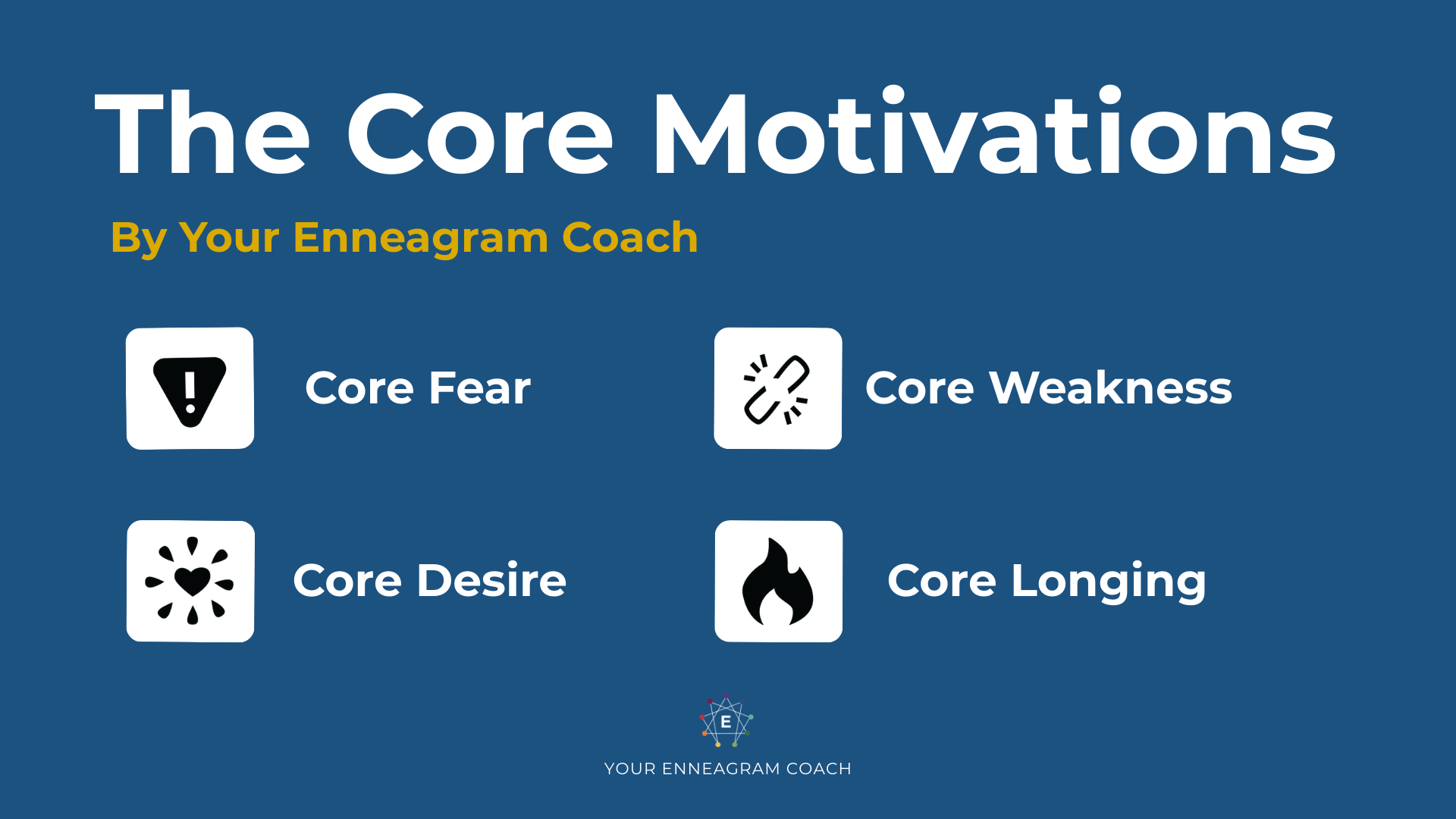
The four Core Motivations are the driving forces behind why each type thinks, feels, and behaves in particular ways.
At Your Enneagram Coach, we always start with the Core Motivations because they are the why behind everything we do. Whether it's how we communicate, handle conflict, or express love, our Core Fear, Desire, Weakness, and Longing shape our relational patterns. When we understand what’s really driving our own behavior—and our partner’s—we can move from frustration to empathy, and from disconnection to deeper connection.
Here are the icons that YEC uses to represent the Core Motivations throughout their work.
Type 2
- Core Fear: Being rejected and unwanted, being thought worthless, needy, inconsequential, dispensable, or unworthy of love.
- Core Desire: Being appreciated, loved, and wanted.
- Core Weakness: Pride—Denying your own needs and emotions while using your strong intuition to discover and focus on the emotions and needs of others, confidently inserting your helpful support in hopes that others will say how grateful they are for your thoughtful care.
- Core Longing: “You are wanted and loved.”
Type 9
- Core Fear: Being in conflict, tension, or discord; feeling shut out and overlooked; losing connection and relationship with others.
- Core Desire: Having inner stability and peace of mind.
- Core Weakness: Sloth—Desire to remain unaffected by life and live in an idealistic, peaceful world by resisting fully awakening to their desires, needs, and abilities. Instead, they prioritize making others happy by merging with them to avoid tension and conflict.
- Core Longing: “Your presence matters.”
The Dance 💃🏽🕺🏼
We created the Dance to show the relational dynamics between two Enneagram types.
The Dance can give you great insight into why you and your partner keep running into the same conflicts over and over again, and help you break free from the unhealthy communication cycles you often repeat.
Understanding "The Dance" in Any Relationship
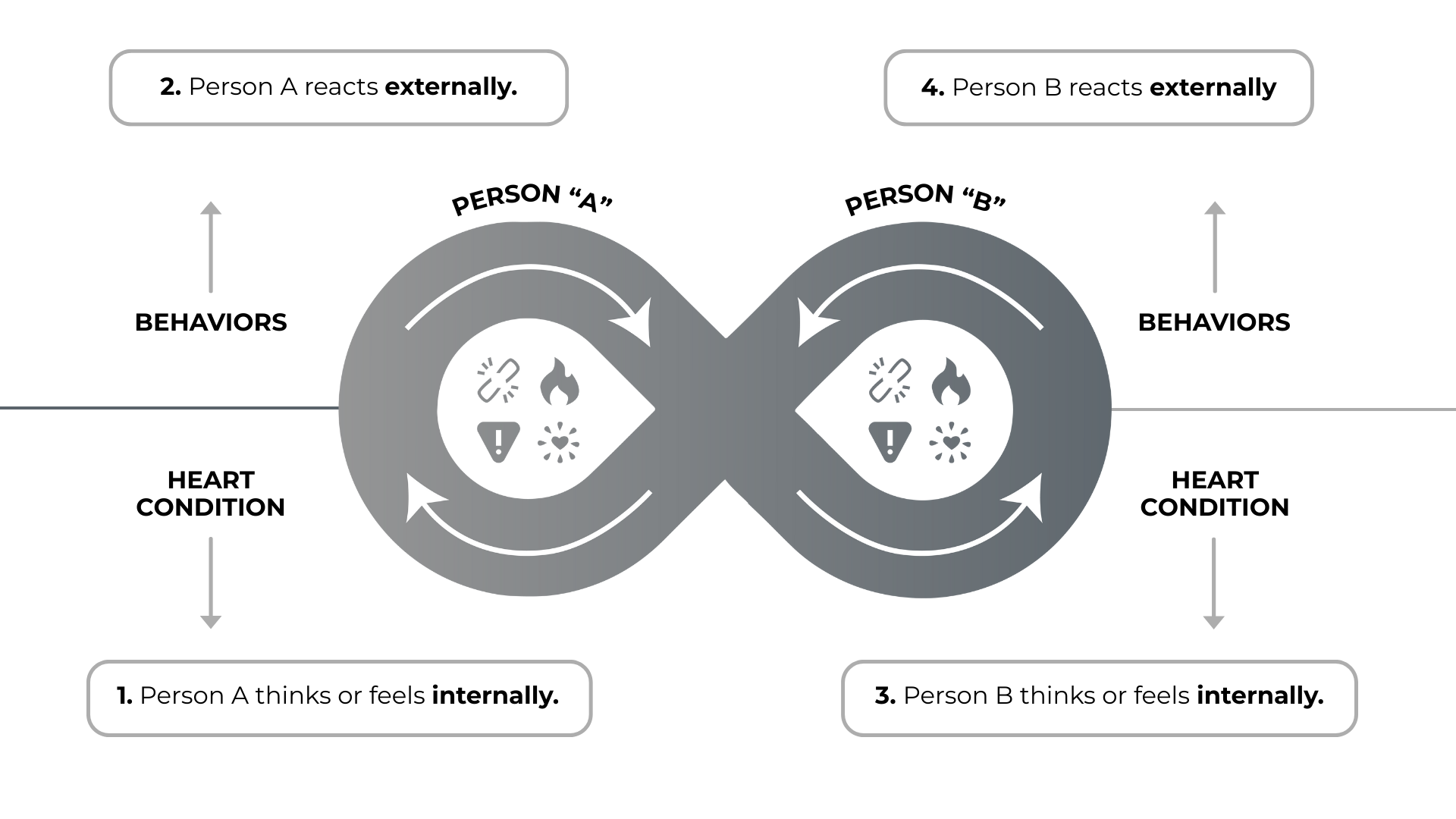
The Dance Diagram (an infinity loop) helps you visualize what’s really happening beneath the surface in any relationship—whether with a spouse, friend, co-worker, or family member.
It shows how each person’s reactions are shaped by their Core Motivations—their Core Fear, Desire, Weakness, and Longing.
We all see life through our unique lens, interpreting and reacting based on how aligned (healthy) or misaligned (unhealthy) we are in the moment.
In the diagram:
- Each loop represents one person in the relationship.
- Inside each person’s loop is their Core Motivations (Core Fear, Desire, Weakness, and Longing).
- Below the line is what’s happening internally—your thoughts, emotions, and Core Motivations (unseen by the other person).
- Above the line is what’s happening externally—your words, tone, and behavior (what the other person does see).
Here’s how The Dance flows:
- Person A thinks or feels internally
- Person A reacts externally
- Person B thinks or feels internally
- Person B reacts externally
🌀 And the cycle continues—until someone becomes aware, pauses, and chooses a healthier response. That’s where real connection begins.
Understanding this cycle provides a practical way to identify what’s truly happening in moments of tension, and to respond with empathy, clarity, and compassion instead of reactivity or assumptions. This is how you begin to create meaningful change in every relationship.
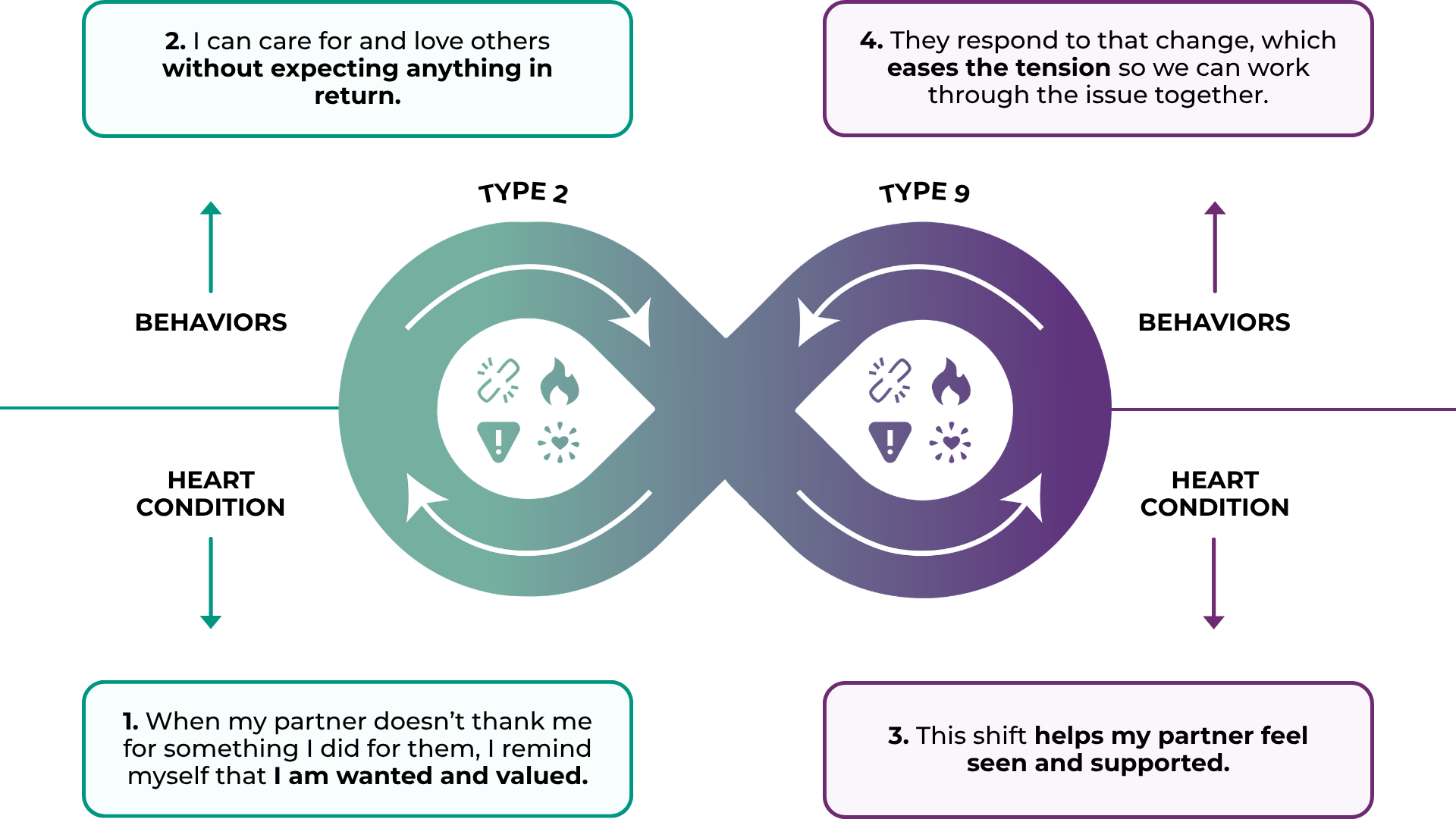
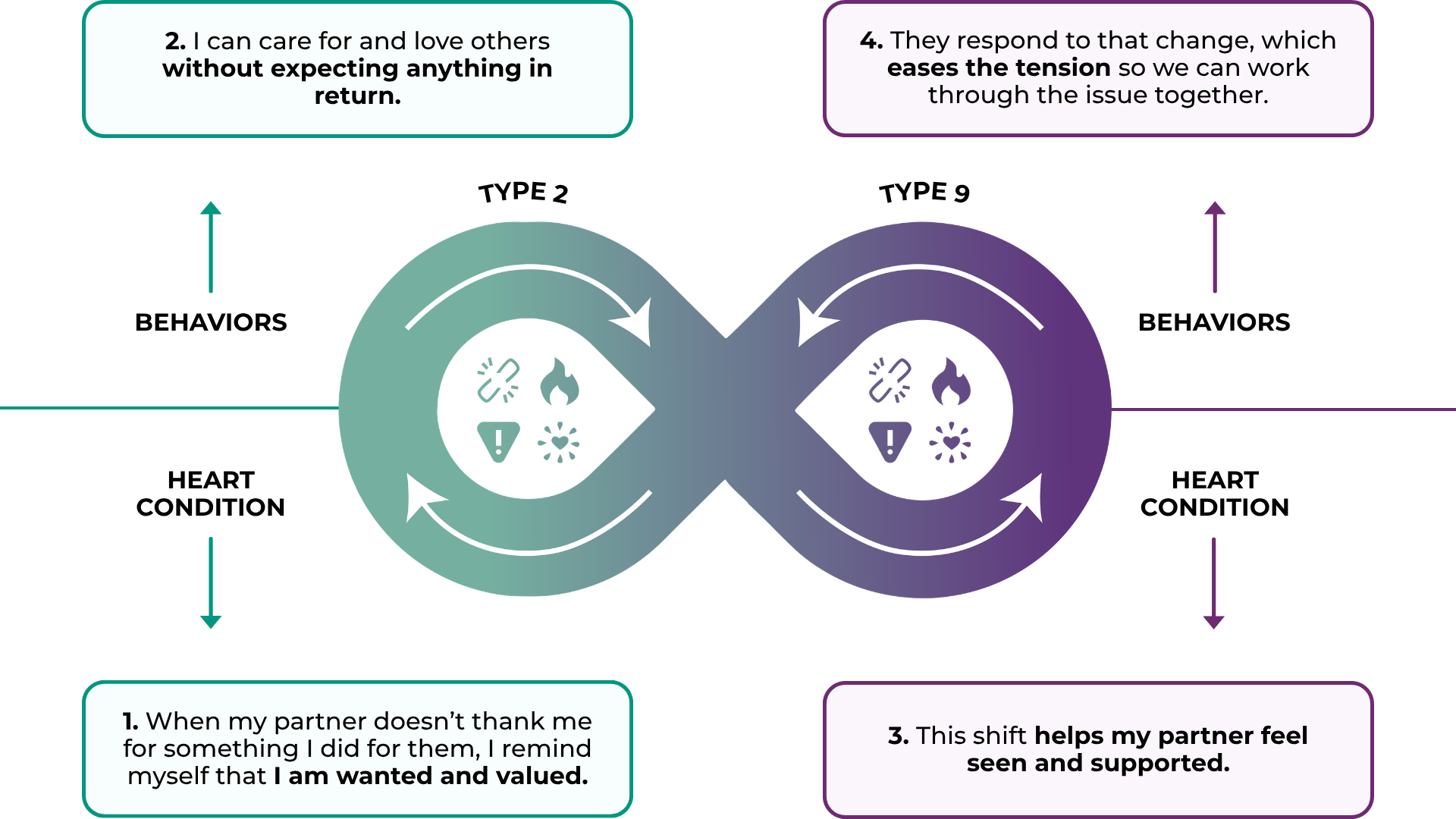
Here is an example of a misaligned dance for Type 2 and Type 9:
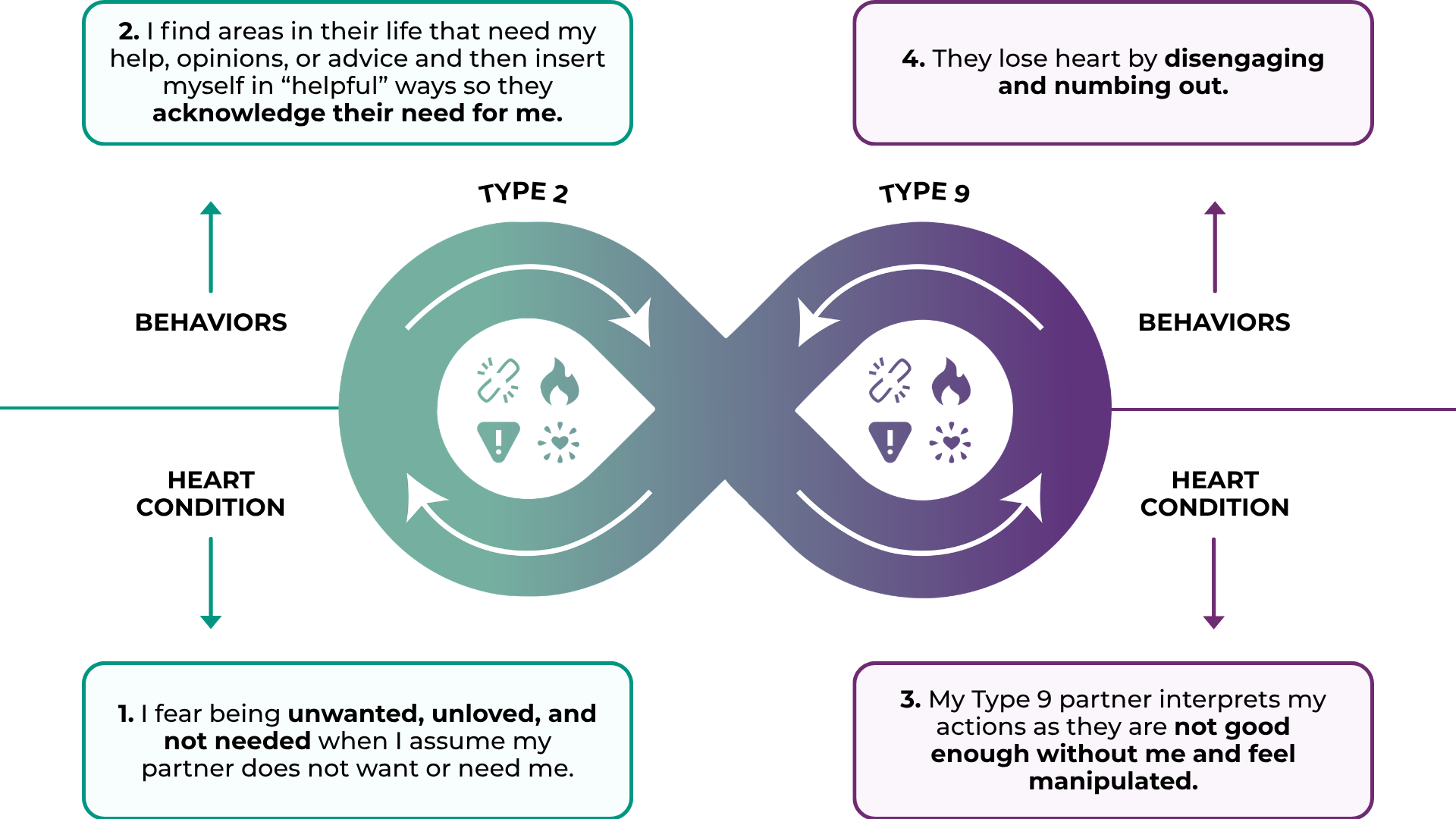
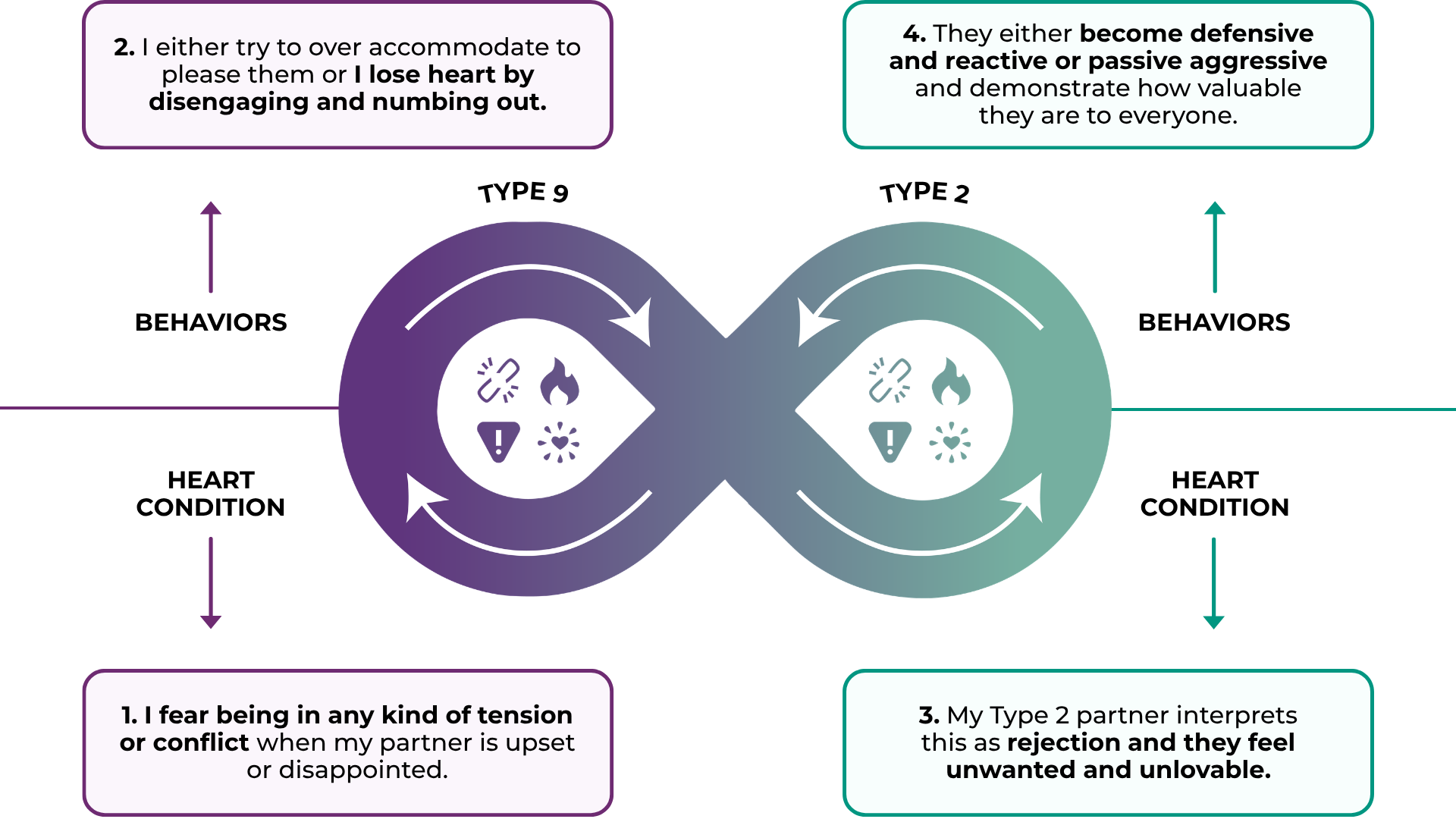
When we’re misaligned, we often engage in a relational dance driven by fear, unmet desires, and unconscious attempts to get our core needs met—usually by expecting our partner to do what only inner growth can provide. This can lead to frustration, disconnection, or even resentment.
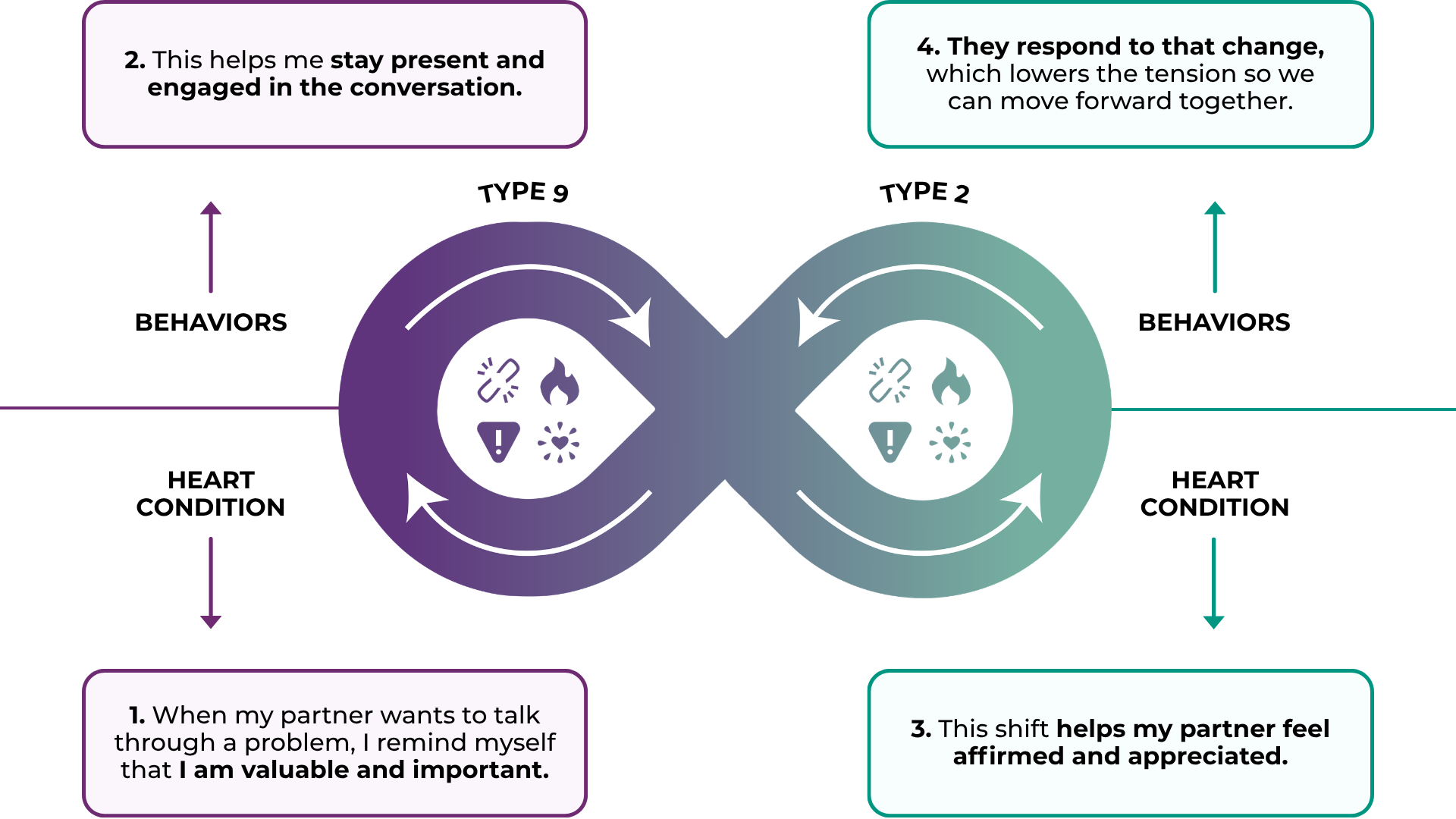
But when we become more aligned with who we are and grow in self-awareness, the dynamic shifts. Here is an example of an aligned dance for Type 2 and Type 9:
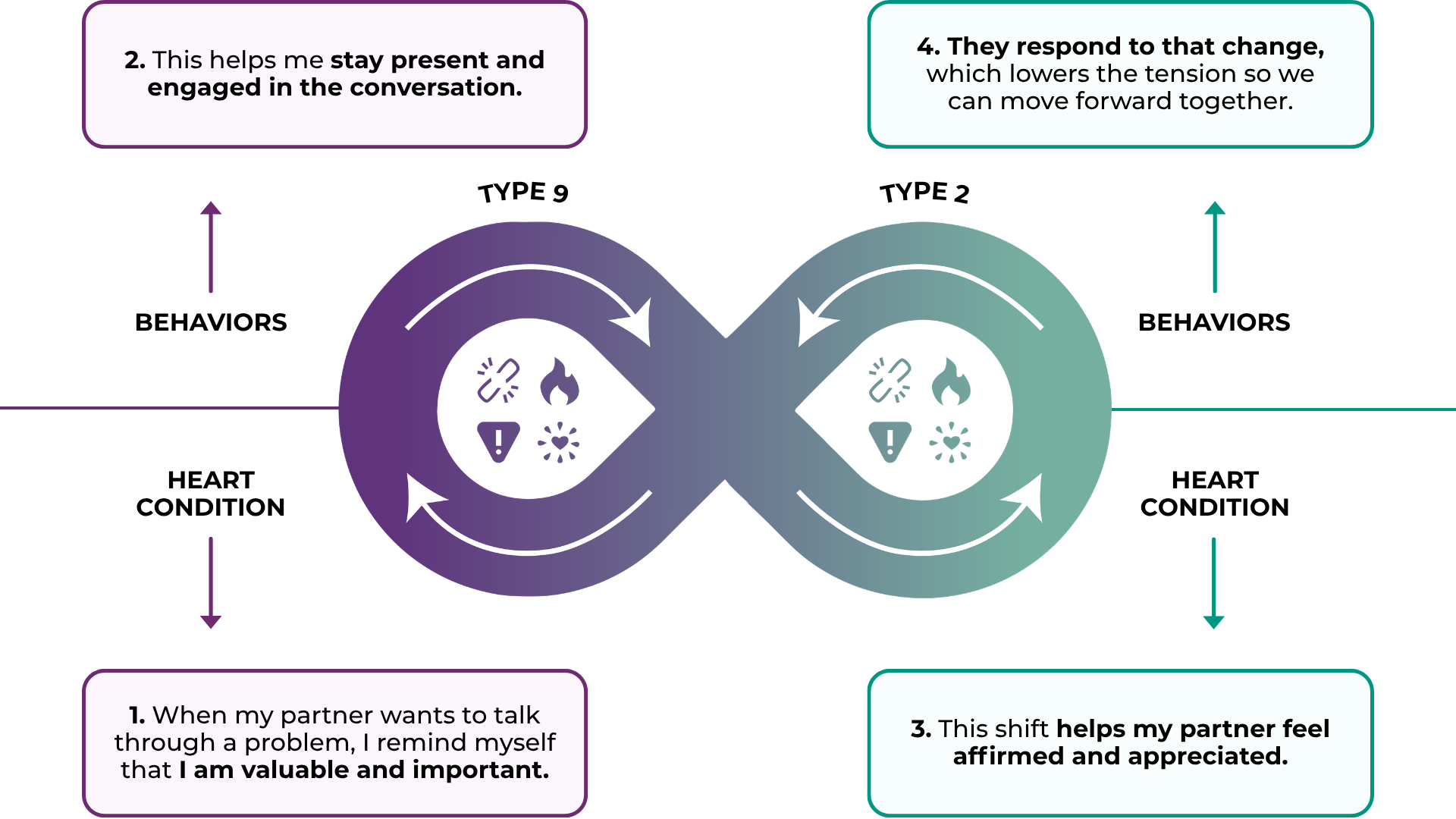
When we are aligned, we begin to recognize our Core Motivations in real time and stop placing the full weight of them on our partner. Instead, we show up with curiosity, grace, and a deeper understanding of what we (and our partner) truly need, creating space for a more balanced, supportive, and connected relationship.
Want to learn more about the dance and how it can help your relationship thrive? Explore our type-specific couple courses—designed to help you grow together with more clarity and connection. Click the link at the bottom of the page to get started!
The Strengths of a Type 2 + Type 9 Relationship 💪
- Complementary Support: Type 2's bring heartfelt warmth and attentiveness, while Type 9's offer steadiness, calm, and acceptance—together creating a peaceful and nurturing foundation.
- Mutual Encouragement: Type 2's inspire 9's to engage more fully in life and relationships, while 9's help 2's slow down, relax, and find ease without always “doing.”
- Shared Harmony: Both value connection and creating a stable, loving atmosphere. Their shared focus on peace and care helps them build a supportive home together.
- Gentle Care: Type 9’s patience soothes Type 2’s emotional intensity, while Type 2’s attentiveness makes Type 9 feel deeply seen and cherished.
Together, they create a relationship filled with comfort, kindness, and acceptance, where love feels steady and safe.
The Challenges of a Type 2 + Type 9 Relationship 💔
- Avoidance vs. Over-giving: Type 9’s tendency to avoid conflict can frustrate Type 2, who craves open acknowledgment of feelings and needs.
- Feeling Unseen: Type 2 may feel invisible or unappreciated when Type 9 withdraws or minimizes issues. Type 9 may feel unseen when Type 2 becomes too dominating in the relationship, taking charge of decisions or overemphasizing their own way of caring without recognizing Type 9’s perspective.
- Over accommodation: Both can lose themselves in the relationship—2's by over-focusing on their partner’s needs, and 9's by merging with their partner instead of asserting their own.
- Conflict Avoidance: Because 9's dislike tension and 2's want to stay “needed,” they may both avoid hard conversations, letting resentments quietly build.
Without conscious effort, the relationship can slip into passivity, codependency, or quiet disconnection.
How Their Core Struggles Affect the Relationship ⚠️
When the 2’s desire to be needed meets the 9’s tendency to avoid conflict, both partners can end up feeling disconnected or unfulfilled:
- Type 2's may over-give, pushing for closeness and recognition, but feel frustrated if their efforts aren’t noticed or reciprocated.
- Type 9's may withdraw or merge, suppressing their own needs to keep the peace, which can make the 2 feel unseen or unappreciated.
- Both may avoid direct communication, with 2's hinting or expecting acknowledgment and 9's minimizing issues to maintain harmony.
This unconscious pattern—over-giving (2) and conflict avoidance or passivity (9)—can leave both partners feeling overlooked, misunderstood, or emotionally distant.
Breaking the Cycle ♾️: Moving Beyond Passivity and Over-giving
For Type 2's and Type 9's to thrive, they need to balance care with self-expression, learning to communicate directly while still honoring harmony.
- Speak up about needs: 2's should express care without expectation, and 9's should share their preferences instead of merging.
- Create space for honesty: Both partners benefit from gently addressing conflict instead of brushing it aside.
- Celebrate individuality: Encourage each other’s separate interests and goals to keep the relationship balanced.
- Balance closeness and autonomy: Stay connected without losing your own identity.
- Face challenges directly: Approach issues with compassion and courage, rather than avoidance.
The Role of Communication in Building a Stronger Bond 💬
For this pairing, communication thrives when both partners feel safe to be authentic without fear of rejection or conflict:
- Express appreciation regularly: 2's feel valued when their care is acknowledged, and 9's feel seen when their steady support and opinions are appreciated.
- Encourage directness: 9's should speak their truth, and 2's should listen without pressure or expectation.
- Share feelings openly: 2's can admit when they feel unappreciated, and 9's can voice their needs instead of retreating.
- Listen without fixing: 2's can avoid over-helping, and 9's can resist minimizing problems—both offering presence instead of quick solutions.
- Anchor your connection: Establish regular check-ins where both partners can share honestly, reducing misunderstandings and building trust.
How Growth and Self-Awareness Strengthen the Relationship 🌱
- Recognize the cycle of over-giving and avoidance. 2's may give excessively to feel needed, while 9's may avoid asserting themselves. Awareness breaks this loop.
- Balance helpfulness with self-expression. 2's grow by caring without overreaching, while 9's grow by standing firm in their own voice.
- Practice grounded presence. Instead of reacting to others’ needs (2) or going along to keep peace (9), both can pause, check in, and respond authentically.
- Value love in different forms. 2's often express love through active care, while 9's show love through steady presence and acceptance. Recognizing these differences helps both feel appreciated.
Final Thoughts: A Partnership of Harmony and Heart
At their best, a Type 2 and a Type 9 create a relationship full of kindness, comfort, and stability. 2's offer warmth and heartfelt connection, while 9's provide calm and unwavering acceptance. Together, they build a haven of safety and love, where both can feel at ease and truly valued. Through honest communication, mutual appreciation, and the courage to face challenges together, this partnership blossoms into one of deep peace and genuine care.
What’s next:
If you’re ready to grow closer and finally understand the unique dynamics of your relationship, the Becoming Us course is your next best step. This personalized experience is tailored to your exact Enneagram Type pairing, walking you through eight transformational modules and a beautifully designed 64-page guidebook that reveals how your personalities dance together, both when you're aligned and when you're misaligned.
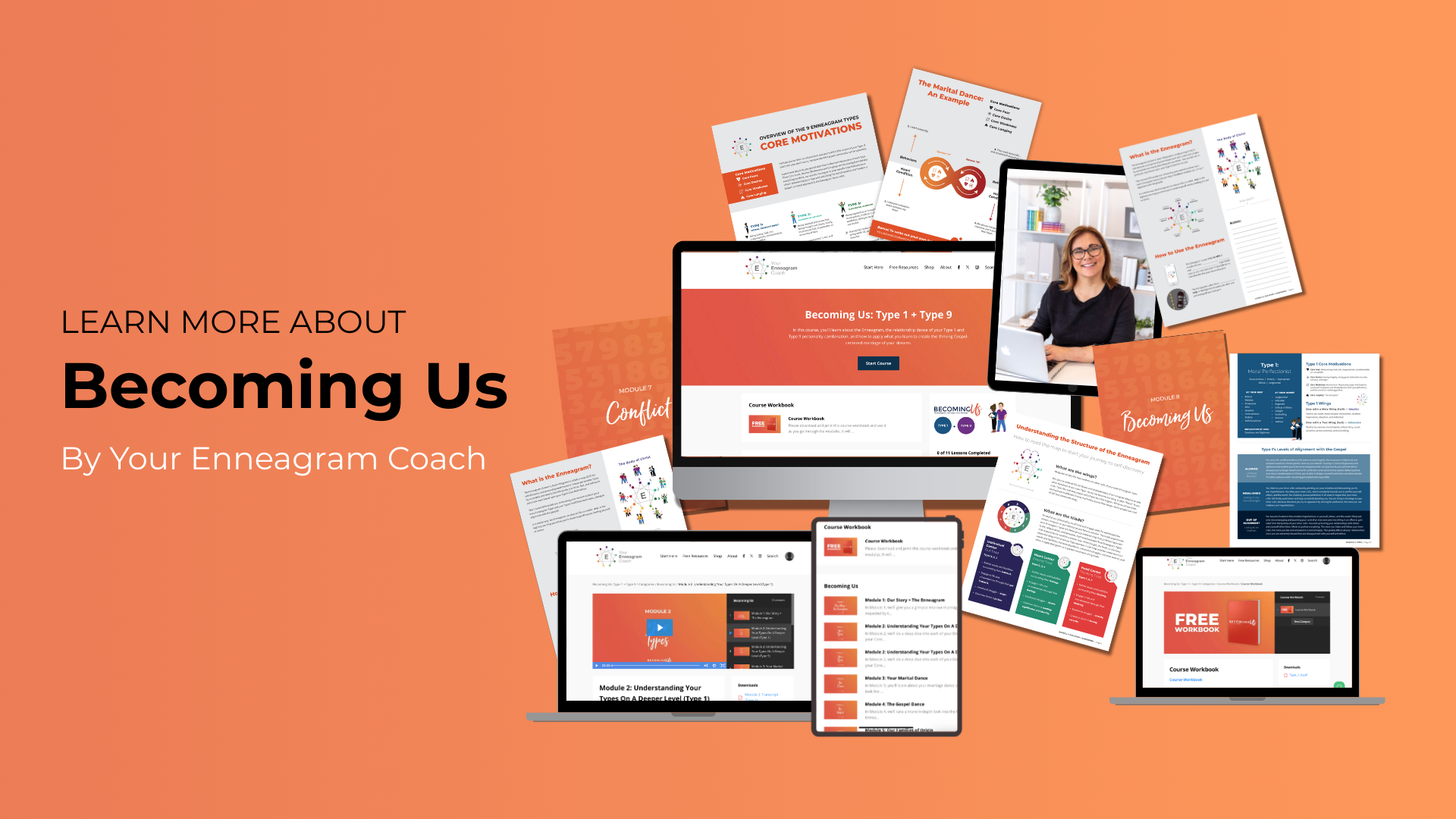
You'll discover the deeper reasons behind your patterns, gain language to navigate conflict with compassion, and find the clarity and direction you’ve been craving. Couples say they finally feel seen, understood, and equipped—and we know you will too. Your relationship is worth investing in. Take advantage of the special sale and start your Becoming Us journey today. Click here to learn more. 💛
Other Great Next Steps:
|
Get astonishing clarity with your couple-type Becoming Us course |
We would love to share some free Enneagram resources with you.