
Type 5 + Type 3 Compatibility 💛💚: Insight Meets Ambition
Mar 06, 2026
A relationship between an Enneagram Type 5 and Type 3 blends thoughtful insight with driven ambition. Type 5's bring depth, objectivity, and a need to understand the world clearly, while Type 3's contribute energy, efficiency, and a strong desire to achieve meaningful goals. Together, they can create a partnership that feels both intelligent and forward-moving. Type 5's offer perspective and strategic thinking, and Type 3's bring momentum and execution. However, their different approaches to engagement can create tension: Type 5's may pull back to conserve energy or process internally, while Type 3's push ahead at full speed, leaving both partners out of sync. The key to a thriving Type 5 + Type 3 relationship lies in balancing reflection with action, honoring different energy levels, and valuing both depth and accomplishment.
But how compatible are Type 5's and Type 3's in a romantic relationship? While their strengths can complement each other beautifully, their contrasting needs for space and productivity can also create friction. Let’s explore how this pairing can flourish, and where intentional growth may be needed.
Understanding the Type 5 and Type 3 Personality in Relationships 💑🏻
Type 5's, also known as the Analytical Investigator or Observer, are independent, perceptive, and driven by a desire to understand. Their core desire is to be competent and capable, while their core fear is being overwhelmed or invaded. They tend to conserve their time and energy, sometimes withdrawing emotionally to recharge. This self-sufficiency can be confusing to more outwardly expressive partners.
Type 3's, also known as the Admirable Achiever or Performer, are ambitious, efficient, and image-conscious. Their core desire is to be seen as successful and worthwhile, while their core fear is being seen as a failure or without value. They tend to adapt themselves to what others admire, often prioritizing achievement over emotional expression, sometimes even avoiding vulnerability in the process.
The Core Motivations of Type 5 and Type 3:
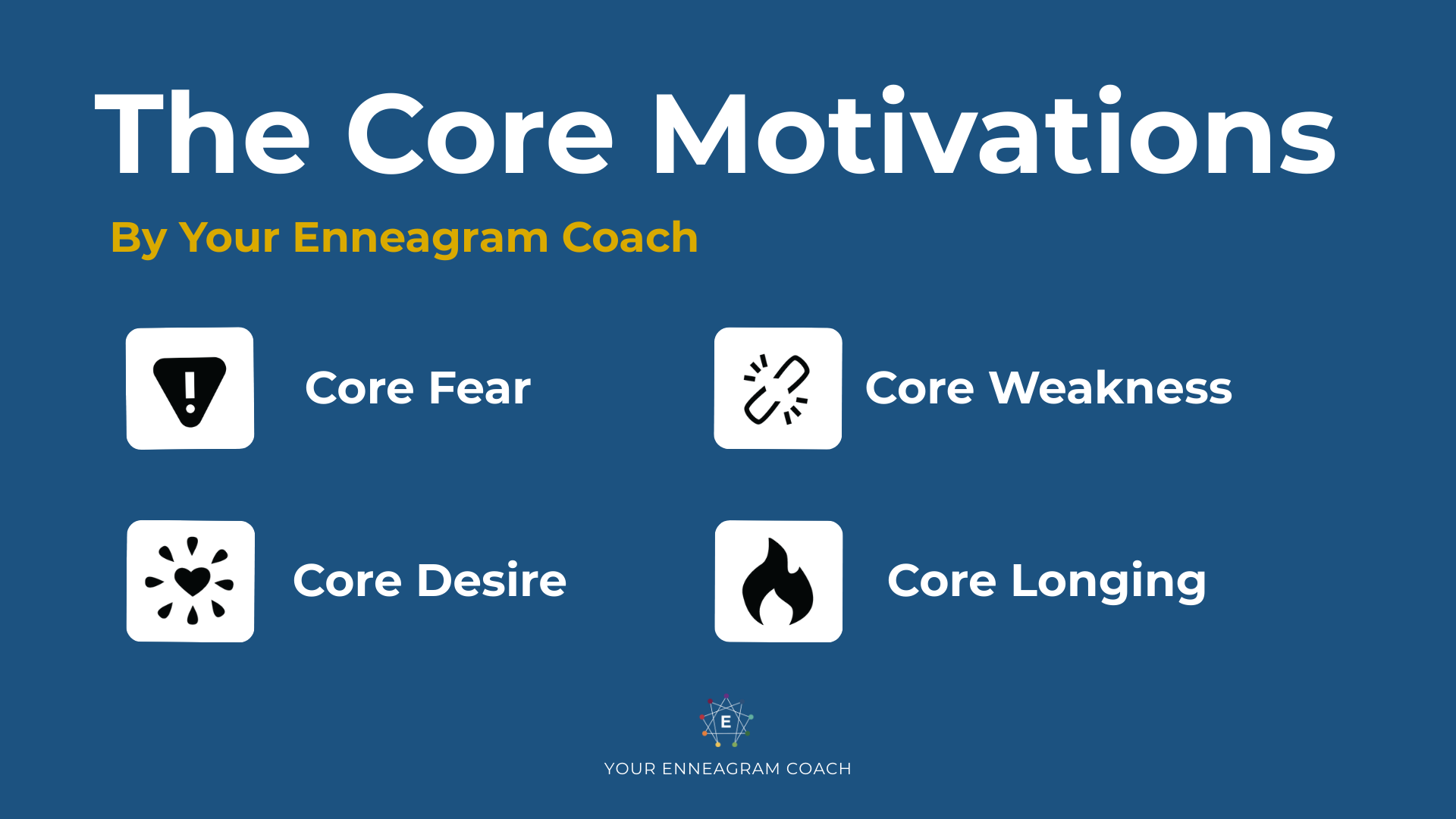
The four Core Motivations are the driving forces behind why each type thinks, feels, and behaves in particular ways.
At Your Enneagram Coach, we always start with the Core Motivations because they are the why behind everything we do. Whether it's how we communicate, handle conflict, or express love, our Core Fear, Desire, Weakness, and Longing shape our relational patterns. When we understand what’s really driving our own behavior—and our partner’s—we can move from frustration to empathy, and from disconnection to deeper connection.
Type 5
- Core Fear: Being annihilated, invaded, or not existing; being thought incapable or ignorant; having obligations placed upon you or your energy being completely depleted.
- Core Desire: Being capable and competent.
- Core Weakness: Avarice—Feeling that you lack inner resources and that too much interaction with others will lead to catastrophic depletion; withholding yourself from contact with the world; holding onto your resources and minimizing your needs.
- Core Longing: “Your needs are not a problem.”
Type 3
- Core Fear: Being exposed as or thought incompetent, inefficient, or worthless; failing to be or appear successful.
- Core Desire: Having high status and respect, being admired, successful, and valuable.
- Core Weakness: Deceit—Deceiving yourself into believing that you are only the image you present to others; embellishing the truth by putting on a polished persona for everyone (including yourself) to see and admire.
- Core Longing: “You are loved for simply being you.”
The Dance 💃🏽🕺🏼
We created the Dance to show the relational dynamics between two Enneagram types.
The Dance can give you great insight into why you and your partner keep running into the same conflicts over and over again, and help you break free from the unhealthy communication cycles you often repeat.
Understanding "The Dance" in Any Relationship
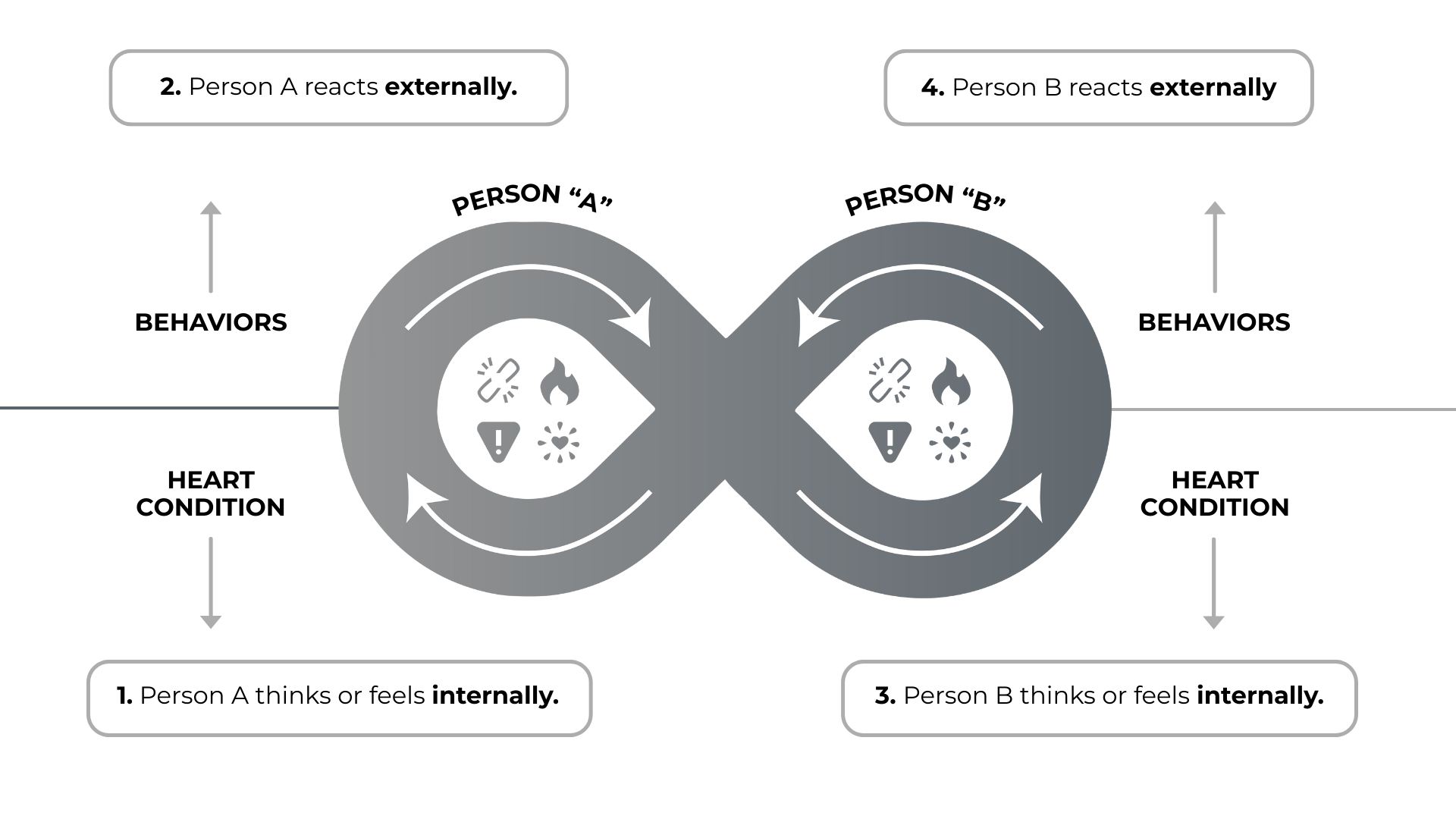
The Dance Diagram (an infinity loop) helps you visualize what’s really happening beneath the surface in any relationship—whether with a spouse, friend, co-worker, or family member.
It shows how each person’s reactions are shaped by their Core Motivations—their Core Fear, Desire, Weakness, and Longing.
We all see life through our unique lens, interpreting and reacting based on how aligned (healthy) or misaligned (unhealthy) we are in the moment.
In the diagram:
- Each loop represents one person in the relationship.
- Inside each person’s loop is their Core Motivations (Core Fear, Desire, Weakness, and Longing).
- Below the line is what’s happening internally—your thoughts, emotions, and Core Motivations (unseen by the other person).
- Above the line is what’s happening externally—your words, tone, and behavior (what the other person does see).
When we don’t consider the hidden motivations below the surface, we often misjudge behaviors and miss what’s really going on. That’s when disconnection happens.
Here’s how The Dance flows:
- Person A thinks or feels internally
- Person A reacts externally
- Person B thinks or feels internally
- Person B reacts externally
🌀 And the cycle continues—until someone becomes aware, pauses, and chooses a healthier response. That’s where real connection begins.
Understanding this cycle provides a practical way to identify what’s truly happening in moments of tension, and to respond with empathy, clarity, and compassion instead of reactivity or assumptions. This is how you begin to create meaningful change in every relationship.
Here is an example of a misaligned dance for Type 5 and Type 3:
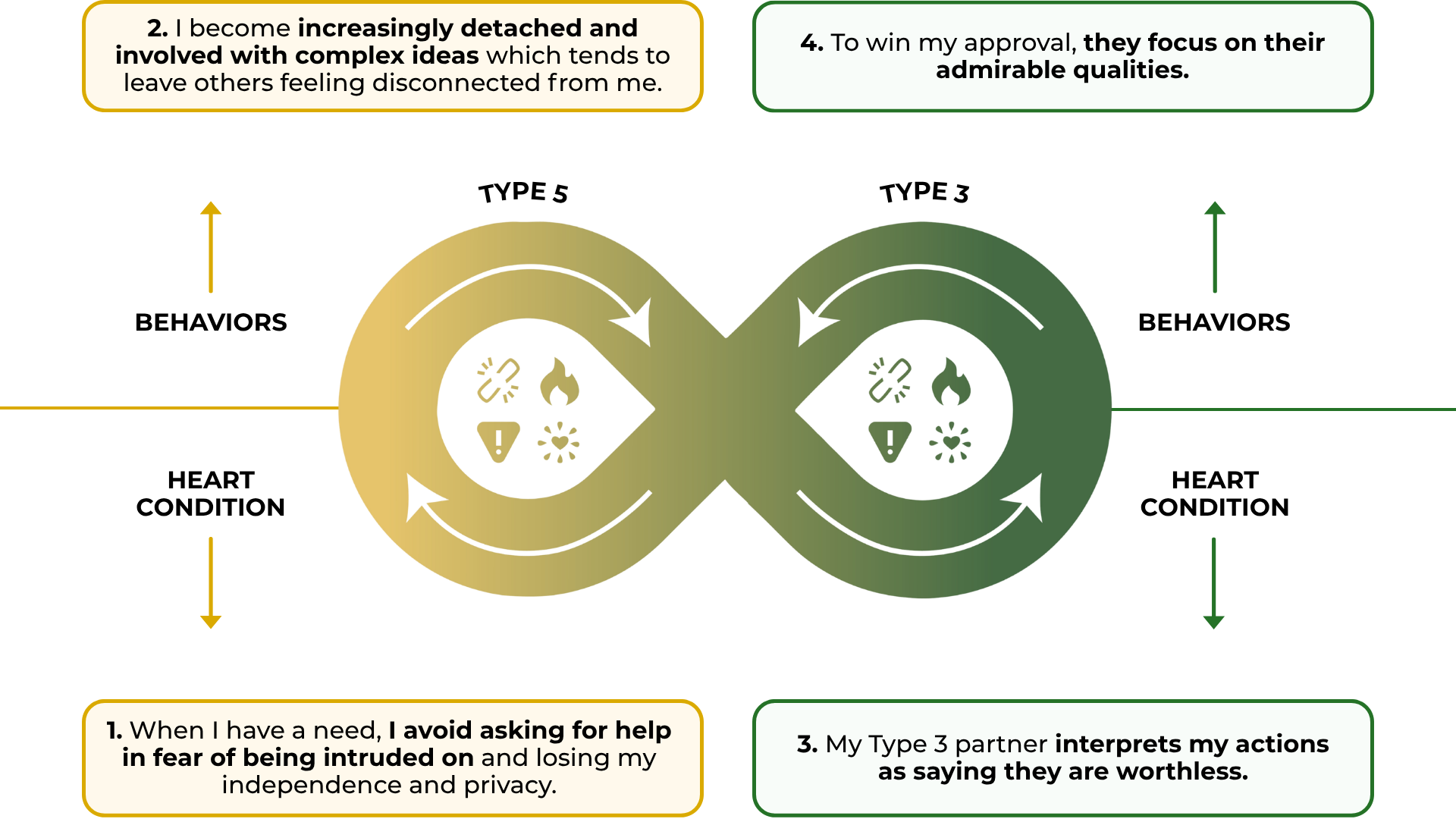
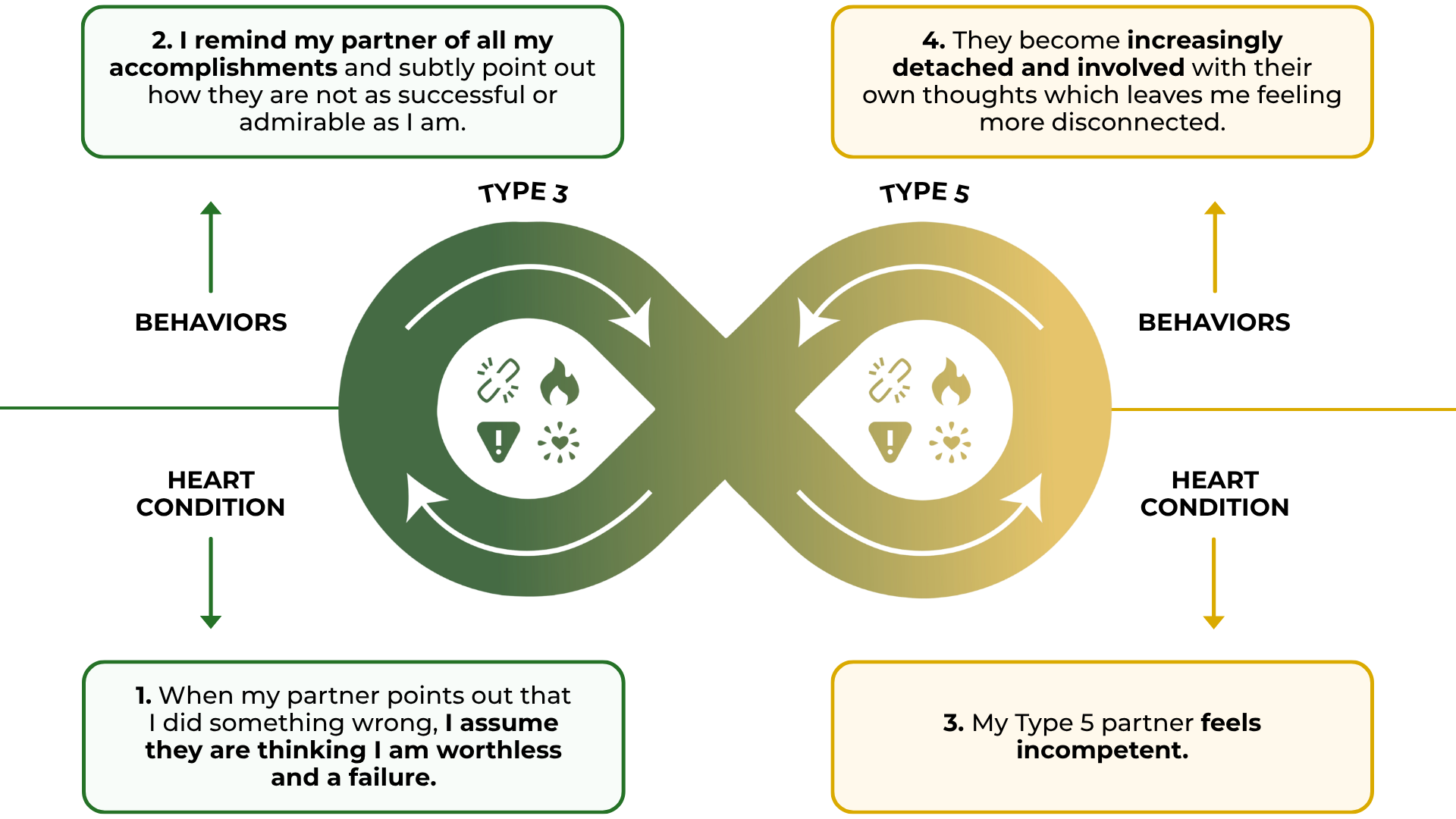
When we’re misaligned, we often engage in a relational dance driven by fear, unmet desires, and unconscious attempts to get our core needs met—usually by expecting our partner to do what only inner growth can provide. This can lead to frustration, disconnection, or even resentment.
But when we become more aligned with who we are and grow in self-awareness, the dynamic shifts. Here is an example of an aligned dance for Type 5 and Type 3:
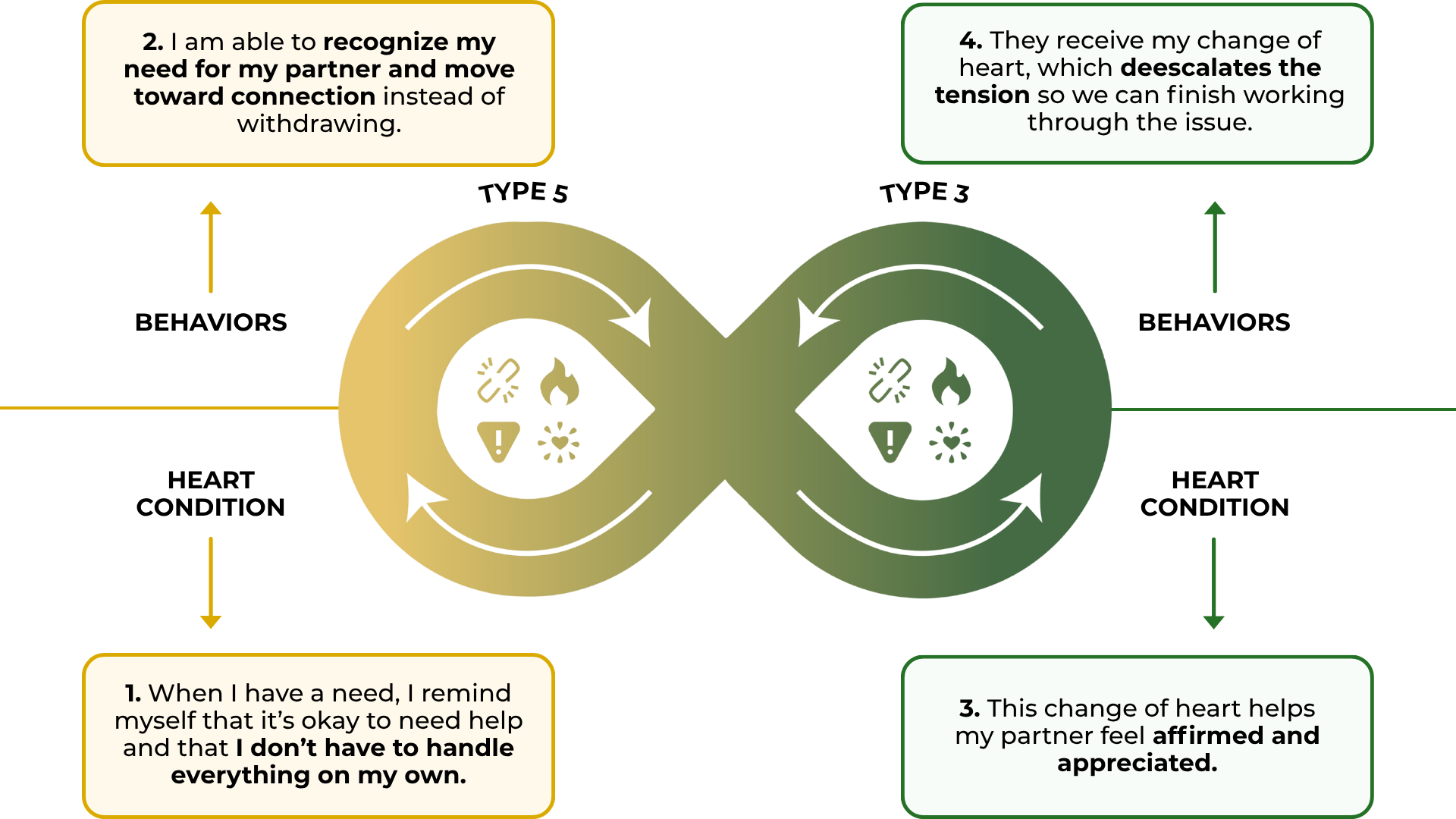
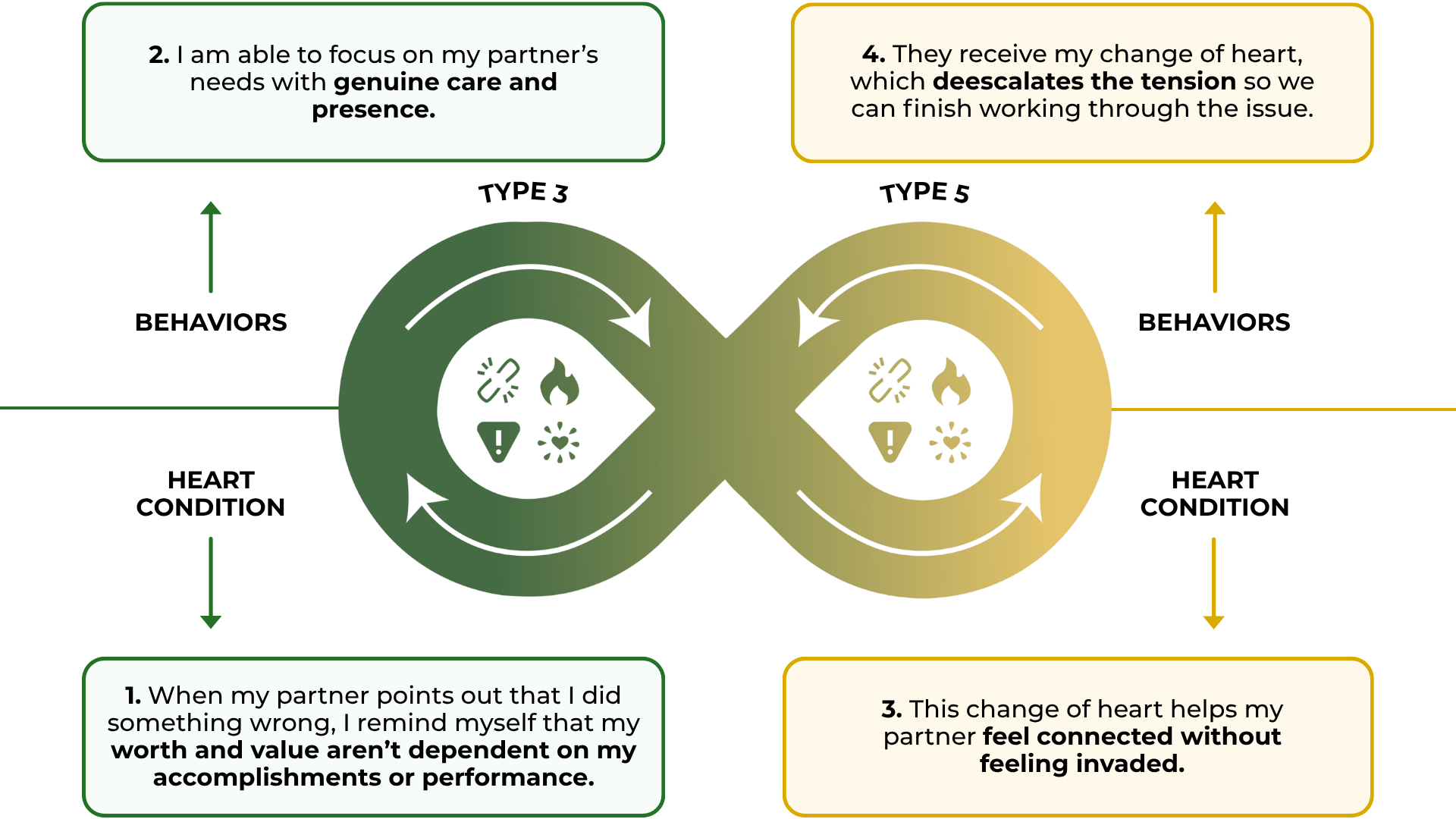
When we are aligned, we begin to recognize our Core Motivations in real time and stop placing the full weight of them on our partner. Instead, we show up with curiosity, grace, and a deeper understanding of what we (and our partner) truly need, creating space for a more balanced, supportive, and connected relationship.
Want to learn more about the dance and how it can help your relationship thrive? Explore our type-specific couple courses—designed to help you grow together with more clarity and connection. Click the link at the bottom of the page to get started!
The Strengths of a Type 5 + Type 3 Relationship 💪
- Insight Meets Drive: Type 5's bring depth, clarity, and thoughtful analysis, while Type 3's bring ambition, energy, and momentum. Together, they combine wisdom with action.
- Complementary Strengths: The Type 5’s ability to think deeply and see systems pairs well with the Type 3’s ability to execute and drive results, creating a partnership that’s both strategic and productive.
- Shared Competence: Both types value capability and effectiveness. They respect each other’s intelligence and skills, often admiring how the other excels in their own lane.
- Mutual Encouragement: Type 3's encourage Type 5's to engage with the world and put their ideas into action, while Type 5's help Type 3's slow down, think critically, and make wiser decisions.
When healthy, this relationship blends insight with achievement, offering both depth and momentum.
The Challenges of a Type 5 + Type 3 Relationship 💔
- Withdrawal vs. Overdrive: Type 5's may withdraw inward to conserve energy, whereas Type 3's push ahead at full speed, creating distance around pace and emotional connection.
- Emotional Mismatch: Type 5's may minimize feelings or need space, while Type 3's may focus on performance or results, leaving both partners feeling unseen.
- Fear of Depletion vs. Fear of Failure: Type 5's may fear being overwhelmed or drained, while Type 3's fear falling behind or not being enough.
- Clashing Needs: The Type 5 may crave autonomy and space, whereas the Type 3 may crave engagement and affirmation; when unmet, these needs can lead to cycles of detachment and frustration.
Without awareness, this dynamic can leave the Type 5 feeling invaded and the Type 3 feeling dismissed.
How Their Core Struggles Affect the Relationship ⚠️
When the Type 3’s drive meets the Type 5’s withdrawal, their struggles may feed into each other:
- Type 3 may over-focus on productivity or image, thereby unintentionally pressuring Type 5 to engage before they’re ready.
- Type 5 may disengage or go quiet, leaving Type 3 feeling unsupported or excluded.
- Both may avoid emotional vulnerability: Type 3's by staying busy, Type 5's by staying detached.
- This can lead to over-functioning on the Type 3’s side and emotional withdrawal on the Type 5’s side, creating imbalance.
This cycle can leave the Type 5 feeling depleted and the Type 3 feeling alone in the relationship.
Breaking the Cycle ♾️: Finding Balance Between Depth and Drive
To thrive together, Type 5's and Type 3's must learn to honor both space and connection. Here’s how:
- Respect energy limits: Type 3's can slow their pace and give space, while Type 5's can communicate boundaries rather than disappear.
- Affirm beyond productivity: Type 3's need appreciation beyond results; Type 5's need reassurance that connection doesn’t require constant output.
- Balance action and reflection: Make room for both thoughtful processing and forward movement.
- Name needs clearly: Type 5's can voice when they need space, and Type 3's can express their desire for engagement without pressure.
- Celebrate insight and execution: Value both the ideas behind the scenes and the results out in the world.
The Role of Communication in Building a Stronger Bond 💬
For this couple, clear and respectful communication is essential:
- Say it directly: Type 5's should state needs plainly instead of withdrawing.
- Slow the pace: Type 3's should pause long enough to check in emotionally, not just operationally.
- Create safe connection: Build moments of low-pressure togetherness.
- Remain curious: Invite understanding rather than assuming motives.
With intentional communication, both partners feel respected, valued, and connected.
How Growth and Self-Awareness Strengthen the Relationship 🌱
This pairing becomes even stronger when both partners:
- Type 5's practice staying present, sharing thoughts and feelings instead of retreating.
- Type 3's release constant performance, allowing vulnerability to deepen intimacy.
- Together, they create a partnership that blends wisdom with action.
- They learn that both space and connection are necessary for lasting closeness.
Over time, they celebrate not only success but also the understanding and trust they’ve built together.
Final Thoughts: A Partnership of Insight and Achievement 💗
At their best, a Type 5 and a Type 3 form a relationship that combines depth and drive. The 3 brings energy and forward motion, while the Type 5 offers perspective and discernment. But to thrive, they must resist the pull toward overdrive and withdrawal. By honoring each other’s needs, communicating clearly, and valuing both presence and progress, this couple can build a relationship that is not only effective on the outside but deeply connected and sustaining at its core.
What’s next:
If you’re ready to grow closer and finally understand the unique dynamics of your relationship, the Becoming Us course is your next best step. This personalized experience is tailored to your exact Enneagram Type pairing, walking you through eight transformational modules and a beautifully designed 64-page guidebook that reveals how your personalities dance together, both when you're aligned and when you're misaligned.

You'll discover the deeper reasons behind your patterns, gain language to navigate conflict with compassion, and find the clarity and direction you’ve been craving. Couples say they finally feel seen, understood, and equipped—and we know you will too. Your relationship is worth investing in. Take advantage of the special sale and start your Becoming Us journey today. Click here to learn more. 💛
Other Great Next Steps:
|
Get astonishing clarity with your couple-type Becoming Us course |
We would love to share some free Enneagram resources with you.