
Type 6 + Type 4 Compatibility 🧡💚: Balancing Security and Depth
Mar 06, 2026
A relationship between an Enneagram Type 6 and Type 4 blends loyalty and emotional intensity. Type 6's bring commitment, dependability, and a strong desire for safety, while Type 4's contribute creativity, sensitivity, and a longing for authenticity. Together, they can form a partnership that is both secure and deeply meaningful, with the Type 6 offering stability and the Type 4 encouraging emotional honesty and self-expression. However, their different approaches to fear and feelings can create challenges. Type 6's may become anxious or overly cautious, while Type 4's may withdraw into moodiness or feel misunderstood. The key to a thriving Type 6 + Type 4 relationship lies in balancing security with emotional openness, making room for both reassurance and authenticity.
But how compatible are Type 6's and Type 4's in a romantic relationship? While their strengths can foster loyalty and depth, their contrasting emotional rhythms and needs can also create tension. Let’s explore how this pairing can grow, and where intentional effort may be needed.
Understanding the Type 6 and Type 4 Personality in Relationships 💑🏻
Type 6's, also known as the Faithful Guardian or Loyalist, bring caution and a deep longing for safety and guidance into their relationships. Their core desire is to feel secure and supported, while their core fear is being without support or guidance. They often anticipate worst-case scenarios, mentally preparing to protect themselves and loved ones from harm. This vigilance makes them dependable partners, but can also lead to anxiety and doubt as they seek reassurance.
Type 4's, often called the Introspective Individualist or Romantic, are creative, emotionally honest, and drawn to authenticity. Their core desire is to be unique and significant, while their core fear is being emotionally misunderstood or seen as lacking identity. They often feel things deeply and seek meaningful connection, though their emotional intensity and desire for authenticity can sometimes be misinterpreted as moodiness or self-absorption.
The Core Motivations of Type 6 and Type 4:
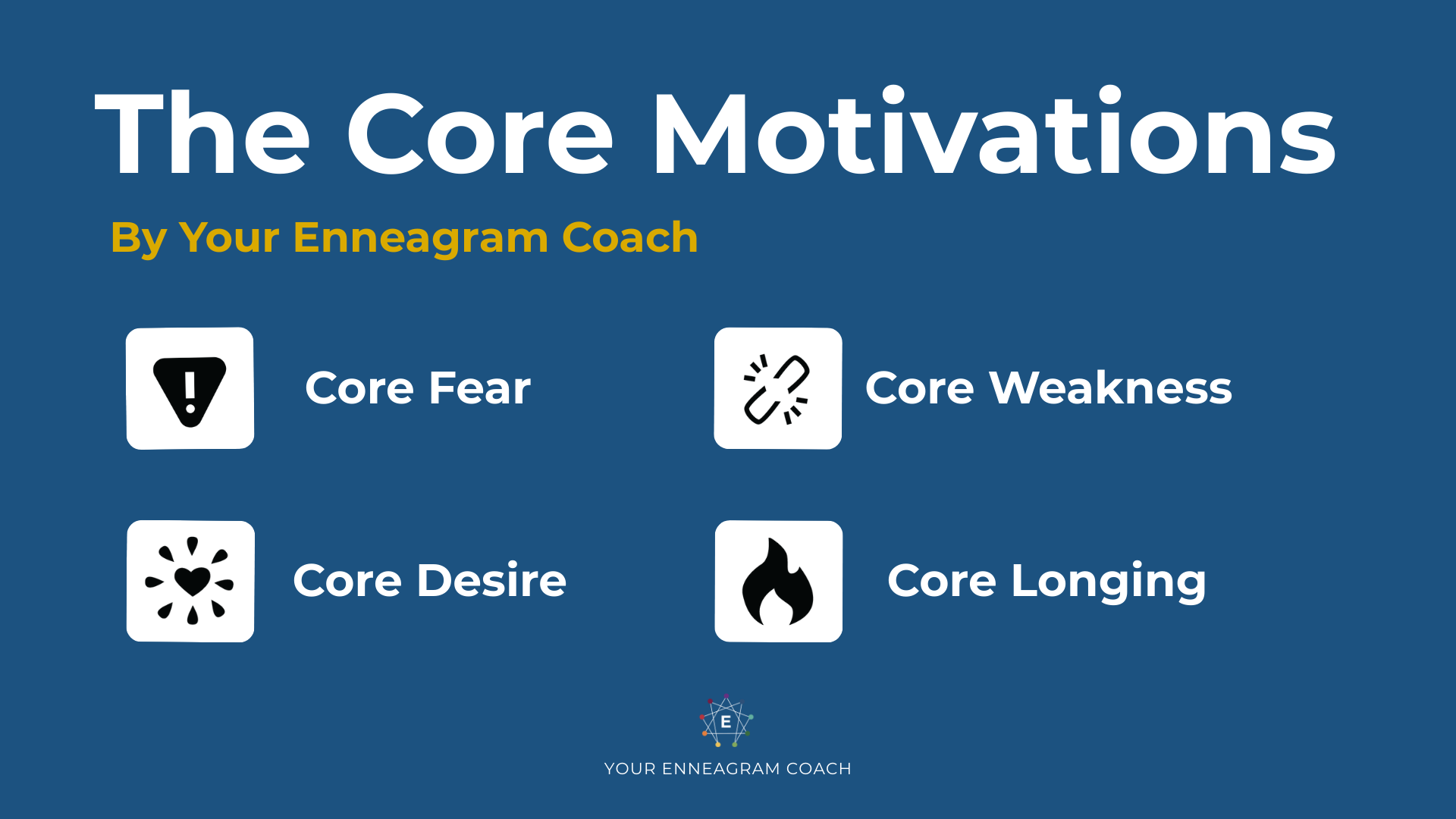
The four Core Motivations are the driving forces behind why each type thinks, feels, and behaves in particular ways.
At Your Enneagram Coach, we always start with the Core Motivations because they are the why behind everything we do. Whether it's how we communicate, handle conflict, or express love, our Core Fear, Desire, Weakness, and Longing shape our relational patterns. When we understand what’s really driving our own behavior—and our partner’s—we can move from frustration to empathy, and from disconnection to deeper connection.
Here are the icons that YEC uses to represent the Core Motivations throughout their work.
Type 6
- Core Fear: Feeling fear itself, being without support, security, or guidance; being blamed, targeted, alone, or physically abandoned.
- Core Desire: Having security, guidance, and support.
- Core Weakness: Anxiety—Scanning the horizon of life and trying to predict and prevent negative outcomes (especially worst-case scenarios); remaining in a constant state of apprehension and worry.
- Core Longing: “You are safe and secure.”
Type 4
- Core Fear: Being inadequate, emotionally cut off, plain, mundane, defective, flawed, or insignificant.
- Core Desire: Being unique, special, and authentic.
- Core Weakness: Envy—Feeling that you’re tragically flawed, something foundational is missing inside you, and others possess qualities you lack.
- Core Longing: “You are seen and loved for exactly who you are—special and unique.”
The Dance 💃🏽🕺🏼
We created the Dance to show the relational dynamics between two Enneagram types.
The Dance can give you great insight into why you and your partner keep running into the same conflicts over and over again, and help you break free from the unhealthy communication cycles you often repeat.
Understanding "The Dance" in Any Relationship
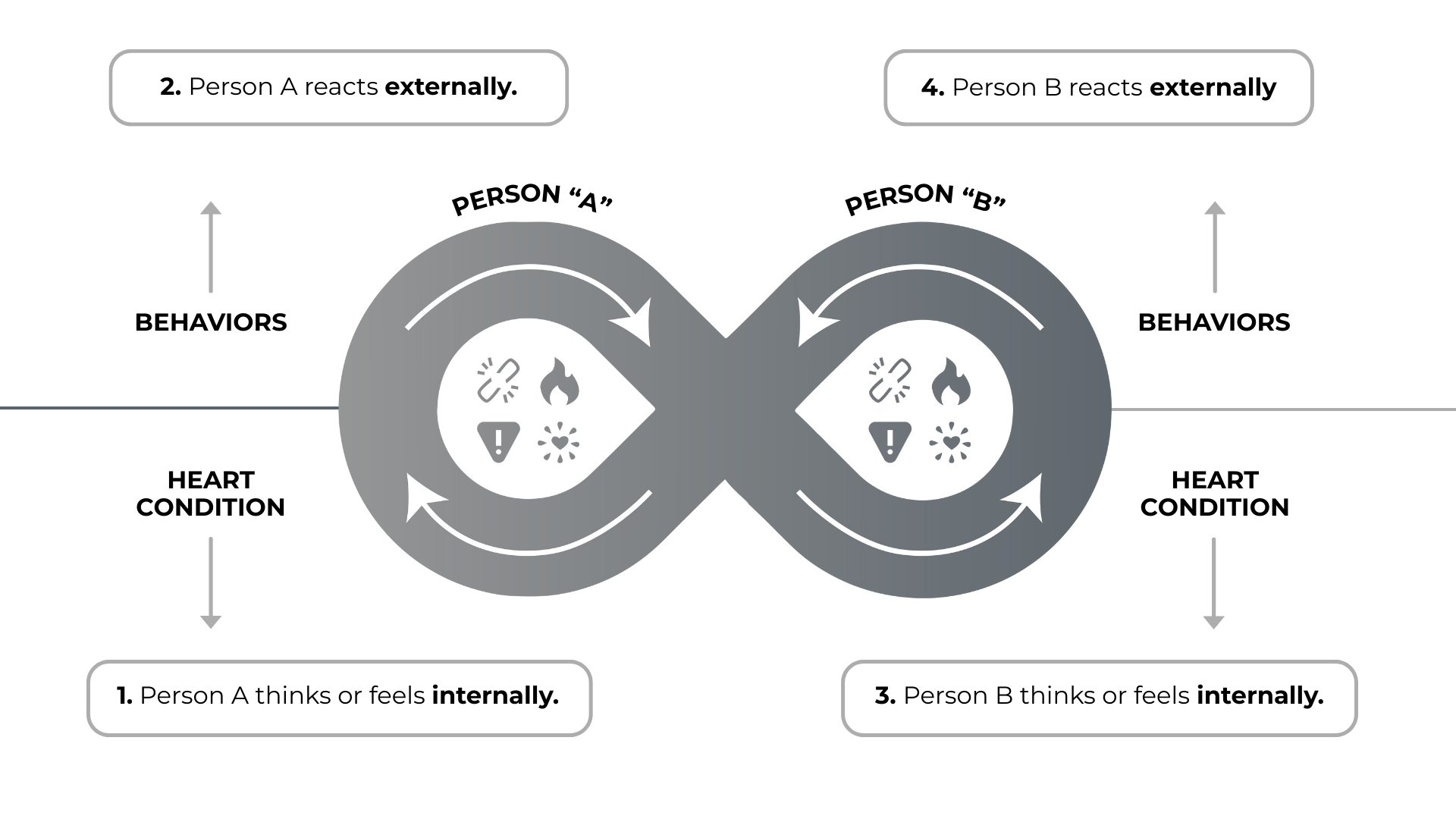
The Dance Diagram (an infinity loop) helps you visualize what’s really happening beneath the surface in any relationship—whether with a spouse, friend, co-worker, or family member.
It shows how each person’s reactions are shaped by their Core Motivations—their Core Fear, Desire, Weakness, and Longing.
We all see life through our unique lens, interpreting and reacting based on how aligned (healthy) or misaligned (unhealthy) we are in the moment.
In the diagram:
- Each loop represents one person in the relationship.
- Inside each person’s loop is their Core Motivations (Core Fear, Desire, Weakness, and Longing).
- Below the line is what’s happening internally—your thoughts, emotions, and Core Motivations (unseen by the other person).
- Above the line is what’s happening externally—your words, tone, and behavior (what the other person does see).
When we don’t consider the hidden motivations below the surface, we often misjudge behaviors and miss what’s really going on. That’s when disconnection happens.
Here’s how The Dance flows:
- Person A thinks or feels internally
- Person A reacts externally
- Person B thinks or feels internally
- Person B reacts externally
🌀 And the cycle continues—until someone becomes aware, pauses, and chooses a healthier response. That’s where real connection begins.
Understanding this cycle provides a practical way to identify what’s truly happening in moments of tension, and to respond with empathy, clarity, and compassion instead of reactivity or assumptions. This is how you begin to create meaningful change in every relationship.
Here is an example of a misaligned dance for Type 6 and Type 4:
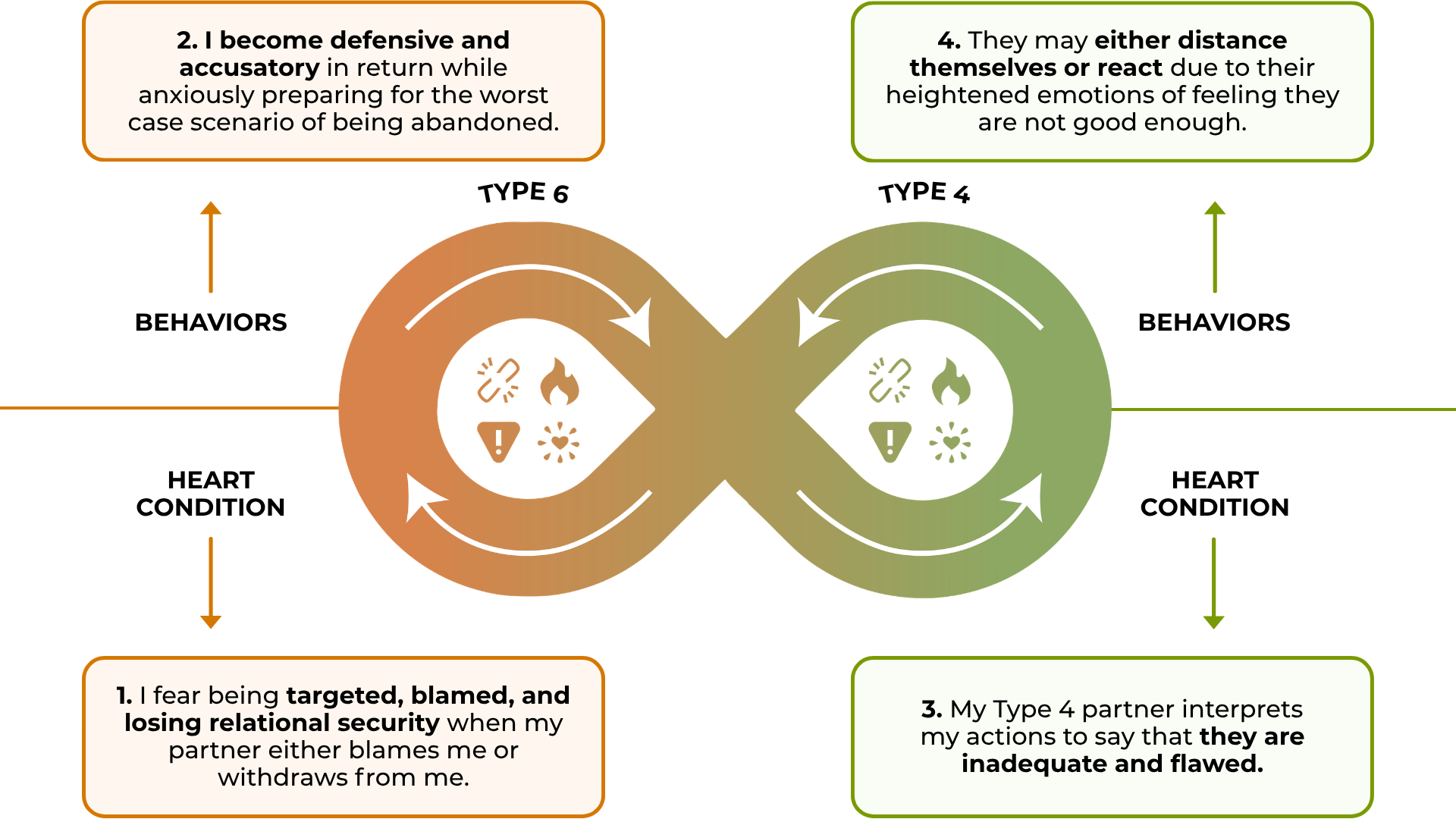
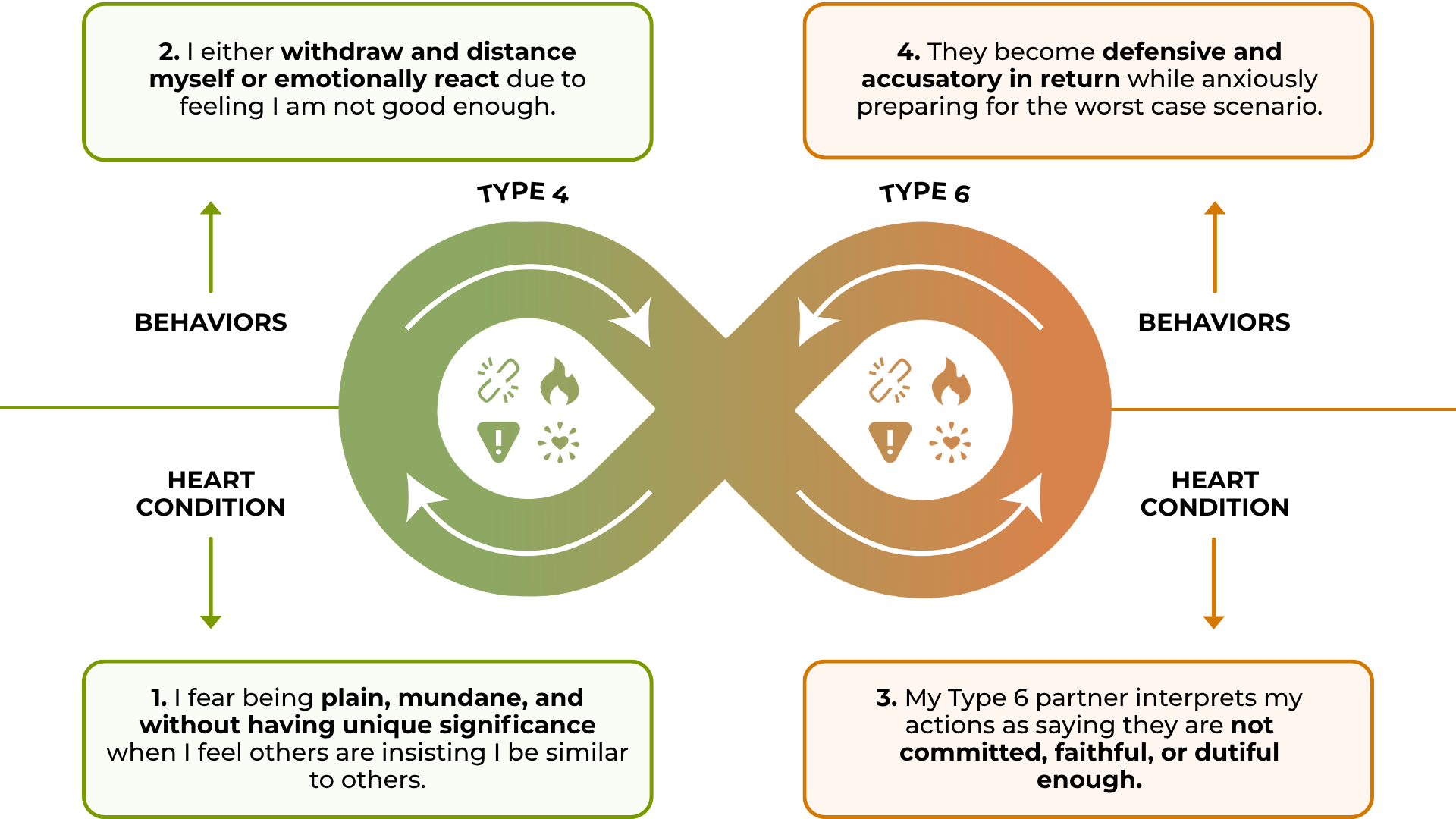
When we’re misaligned, we often engage in a relational dance driven by fear, unmet desires, and unconscious attempts to get our core needs met—usually by expecting our partner to do what only inner growth can provide. This can lead to frustration, disconnection, or even resentment.
But when we become more aligned with who we are and grow in self-awareness, the dynamic shifts. Here is an example of an aligned dance for Type 6 and Type 4:
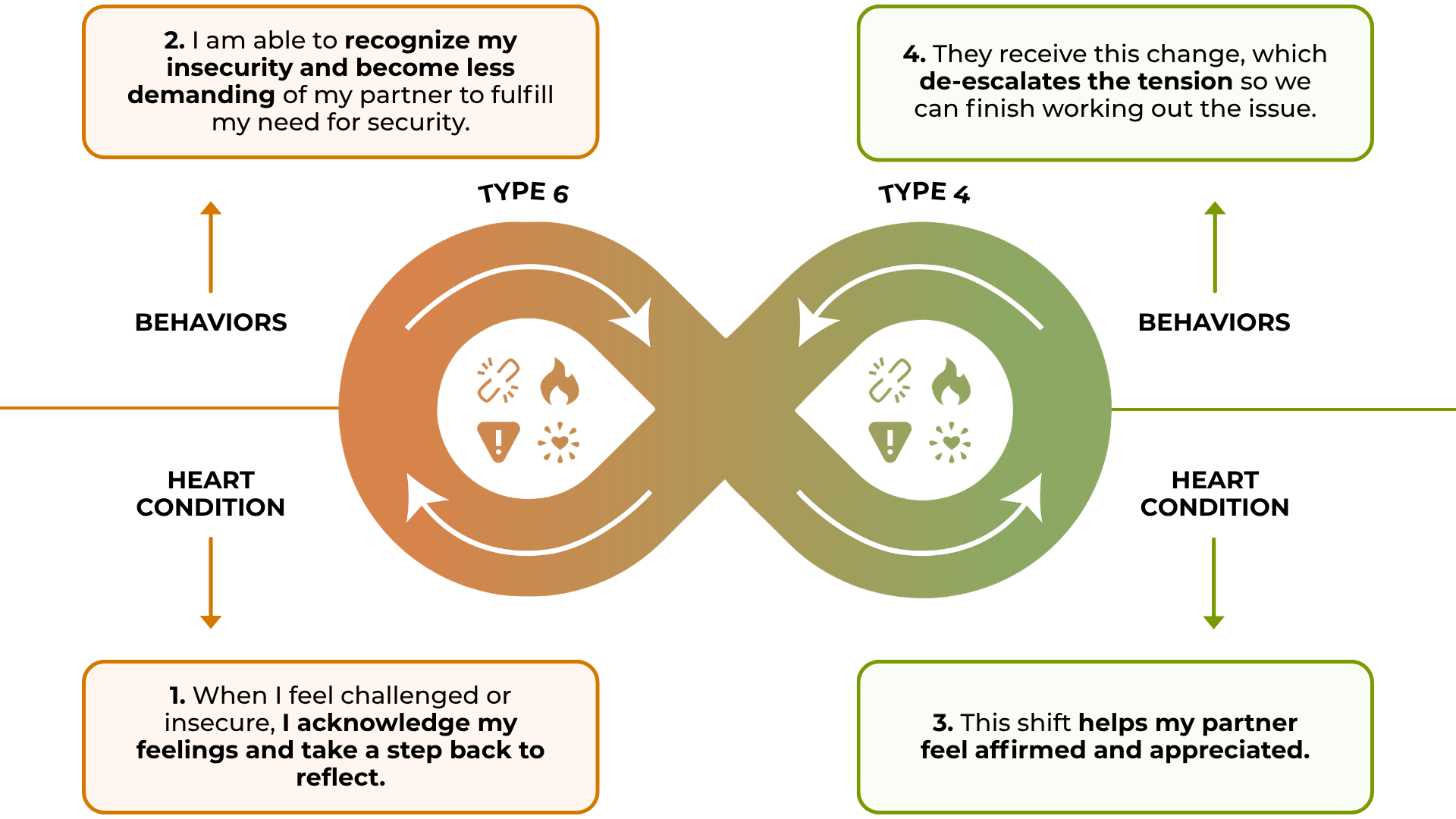
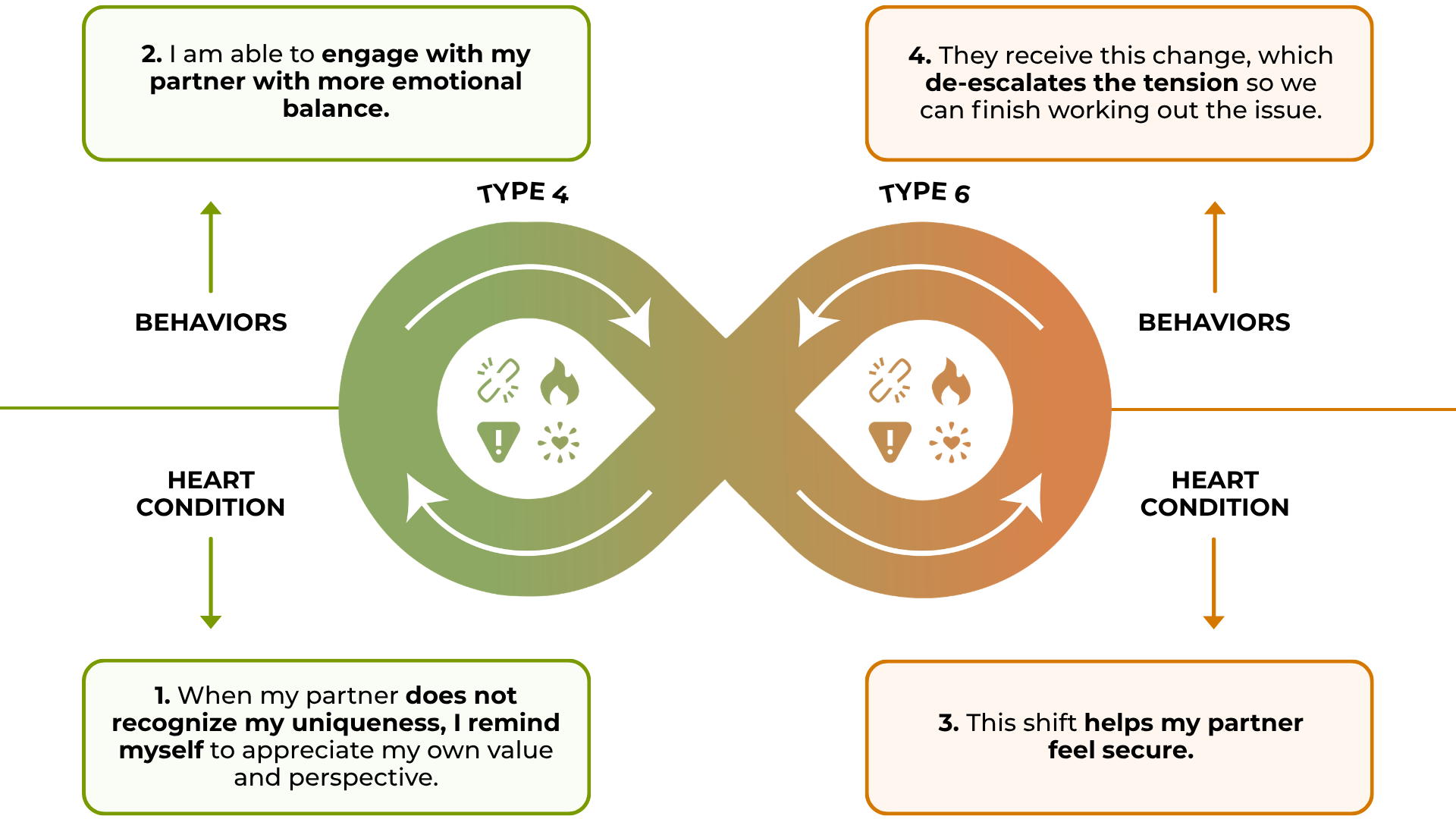
When we are aligned, we begin to recognize our Core Motivations in real time and stop placing the full weight of them on our partner. Instead, we show up with curiosity, grace, and a deeper understanding of what we (and our partner) truly need, creating space for a more balanced, supportive, and connected relationship.
Want to learn more about the dance and how it can help your relationship thrive? Explore our type-specific couple courses—designed to help you grow together with more clarity and connection. Click the link at the bottom of the page to get started!
The Strengths of a Type 6 + Type 4 Relationship 💪
- Balance of Security and Depth: Type 6's bring loyalty, dependability, and grounding, while Type 4's bring emotional depth, creativity, and authenticity. Together, they create a relationship that feels both safe and meaningful.
- Complementary Strengths: The Type 6’s practicality and devotion pair beautifully with the Type 4’s ability to express rich inner emotions, providing the relationship with emotional stability and vibrancy.
- Shared Desire for Connection: Both deeply value intimacy and authenticity, making their bond feel honest, raw, and deeply invested.
- Encouragement to Grow: Type 6's help calm the Type 4’s emotional storms with steady presence, while Type 4's invite Type 6's to explore their emotions and embrace more self-expression.
When both partners are healthy, this relationship combines reliability with depth, forming a partnership that is both secure and profoundly authentic.
The Challenges of a Type 6 + Type 4 Relationship 💔
- Anxiety vs. Intensity: Type 6's may spiral into worry and questioning, while Type 4's may dive into emotional intensity, together, this can create a storm of reactivity.
- Fear of Rejection: Type 6's may worry about being abandoned or betrayed, while Type 4's may fear being misunderstood or unseen for who they truly are.
- Emotional Weight: Type 6's may feel weighed down by the Type 4’s shifting moods, while Type 4s may feel frustrated by the Type 6’s constant need for reassurance.
- Clashing Coping Styles: Type 6's may seek reassurance through loyalty and testing, while Type 4's may withdraw or dramatize emotions, leaving both feeling insecure.
Without awareness, this pairing can slip into a cycle of worry and longing, with the Type 6 seeking stability and the Type 4 amplifying emotions to feel understood.
How Their Core Struggles Affect the Relationship ⚠️
When the Type 6’s anxiety meets the Type 4’s longing, their struggles may unintentionally magnify each other:
- Type 6's may become overly dependent, questioning, or doubting the relationship.
- Type 4's may heighten emotional intensity, hoping for validation, but in the process, they can overwhelm their partner.
- Both may become reactive: Type 6's with anxiety and questioning, Type 4's with emotional intensity and longing—fueling conflict instead of connection.
- This cycle can leave one partner feeling burdened with responsibility (the Type 6) and the other feeling unseen or misunderstood (the Type 4).
This unconscious loop can create tension, with one partner over-functioning while the other leans into emotional intensity, leaving both exhausted.
Breaking the Cycle ♾️: Finding Balance Through Security and Authenticity
To thrive together, Type 6's and Type 4's must learn to balance security with emotional honesty. Here’s how:
- Build emotional safety: Type 6's can remain steady without over-questioning, while Type 4's can share their emotions without overwhelming others.
- Speak needs directly: Type 6's should express fears openly instead of testing, while Type 4's should share feelings without over-dramatizing.
- Balance reassurance and independence: Type 6's can ease their need for constant certainty, while Type 4's can ground their emotions in steadiness and connection.
- Notice reactive cycles: Pause before spiraling—Type 6's from anxiety, Type 4's from intensity—to re-center together.
- Celebrate strengths: Value the Type 6’s steadfastness and the Type 4’s authenticity as complementary gifts.
The Role of Communication in Building a Stronger Bond 💬
For this couple, communication is the glue that holds everything together:
- Validate openly: Type 6's need reassurance, while Type 4's need to feel seen, acknowledge both.
- Be direct: Avoid passive testing (Type 6) or withdrawing into moods (Type 4). Say what you need.
- Share appreciation often: Type 6's thrive when their loyalty is valued; Type 4's thrive when their uniqueness is recognized.
- Stay grounded in conflict: Slow down reactivity and choose empathy over defensiveness.
With intentional communication, both can feel secure, validated, and connected.
How Growth and Self-Awareness Strengthen the Relationship 🌱
This pairing thrives when both partners can:
- Type 6's trust themselves more: Relying on inner guidance reduces fear and reactivity.
- Type 4's practice emotional balance: Allowing steadiness and perspective keeps moods from overwhelming the bond.
- Together, they build a life of safety and depth: The Type 6 provides practical grounding, while the Type 4 brings richness and creativity.
- They learn to celebrate connection as it is, instead of doubting or longing for something missing.
Final Thoughts: A Partnership of Loyalty and Depth 💗
At their best, a Type 6 and a Type 4 create a relationship that feels both safe and deeply meaningful. The Type 6 brings loyalty, stability, and dedication, while the Type 4 adds creativity, authenticity, and emotional richness. But to flourish, they must resist the cycle of fear and longing. By practicing trust, emotional honesty, and mutual reassurance, this couple can build a bond that is not only secure but also soulful, passionate, and deeply authentic.
What’s next:
If you’re ready to grow closer and finally understand the unique dynamics of your relationship, the Becoming Us course is your next best step. This personalized experience is tailored to your exact Enneagram Type pairing, walking you through eight transformational modules and a beautifully designed 64-page guidebook that reveals how your personalities dance together, both when you're aligned and when you're misaligned.
You'll discover the deeper reasons behind your patterns, gain language to navigate conflict with compassion, and find the clarity and direction you’ve been craving. Couples say they finally feel seen, understood, and equipped—and we know you will too. Your relationship is worth investing in. Take advantage of the special sale and start your Becoming Us journey today. Click here to learn more. 💛
Other Great Next Steps:
|
Get astonishing clarity with your couple-type Becoming Us course |
We would love to share some free Enneagram resources with you.