
Type 1 + Type 3 Compatibility 💙: Finding Balance Between Integrity and Ambition
Jan 11, 2026
A relationship between an Enneagram Type 1 and Type 3 can be a dynamic and inspiring match. Type 1 brings a strong sense of integrity and purpose, while Type 3 brings energy, drive, and the ability to get things done. Together, they can make an incredible team—motivated, mission-driven, and deeply committed to excellence.
But how compatible are Type 1 & Type 3 in a romantic relationship? Their different ways of expressing value and pursuing goals can lead to tension if they don’t slow down to understand each other. Let’s explore what makes this pairing work—and where challenges may arise.
Understanding the Type 1 and Type 3 Personality in Relationships 💑🏻
Type 1s, also known as the Principled Reformer or Perfectionists, are disciplined and committed to doing what is right. Their core desire is to be good and ethical, while their core fear is being seen as bad, corrupt, or flawed. They have a strong inner critic that constantly evaluates their own actions—and that same critical voice can also turn outward, judging their partner’s choices, behaviors, or efforts.
Type 3s, also known as the Admirable Achiever or Performer, are driven, adaptable, and focused on success. Their core desire is to be admired and valuable, while their core fear is feeling incompetent or a failure. They often shape-shift to meet expectations and maintain an image of success—and this performance mindset can carry into relationships, sometimes making it hard for them to slow down or show vulnerability.
The Core Motivations of Type 1 and Type 3
The four Core Motivations are the driving forces behind why each type thinks, feels, and behaves in particular ways. At Your Enneagram Coach, we always start with the Core Motivations because they are the why behind everything we do. Whether it's how we communicate, handle conflict, or express love, our Core Fear, Desire, Weakness, and Longing shape our relational patterns. When we understand what’s really driving our own behavior—and our partner’s—we can move from frustration to empathy, and from disconnection to deeper connection.
Type 1
- Core Fear: Being wrong, bad, evil, inappropriate, unredeemable, or corruptible.
- Core Desire: Having integrity, being good, balanced, accurate, virtuous, and right.
- Core Weakness: Resentment—Repressing anger that leads to continual frustration and dissatisfaction with yourself, others, and the world for not being perfect.
- Core Longing: “You are good.”
Type 3
- Core Fear: Being exposed as or thought incompetent, inefficient, or worthless; failing to be or appear successful.
- Core Desire: Having high status and respect, being admired, successful, and valuable.
- Core Weakness: Deceit—Deceiving yourself into believing that you are only the image you present to others; embellishing the truth by putting on a polished persona for everyone (including yourself) to see and admire.
- Core Longing: “You are loved for simply being you.”
The Dance 💃🏽🕺🏼
We created the Dance to show the relational dynamics between two Enneagram types. The Dance can give you great insight into why you and your partner keep running into the same conflicts over and over again, and help you break free from the unhealthy communication cycles you often repeat.
Understanding "The Dance" in Any Relationship
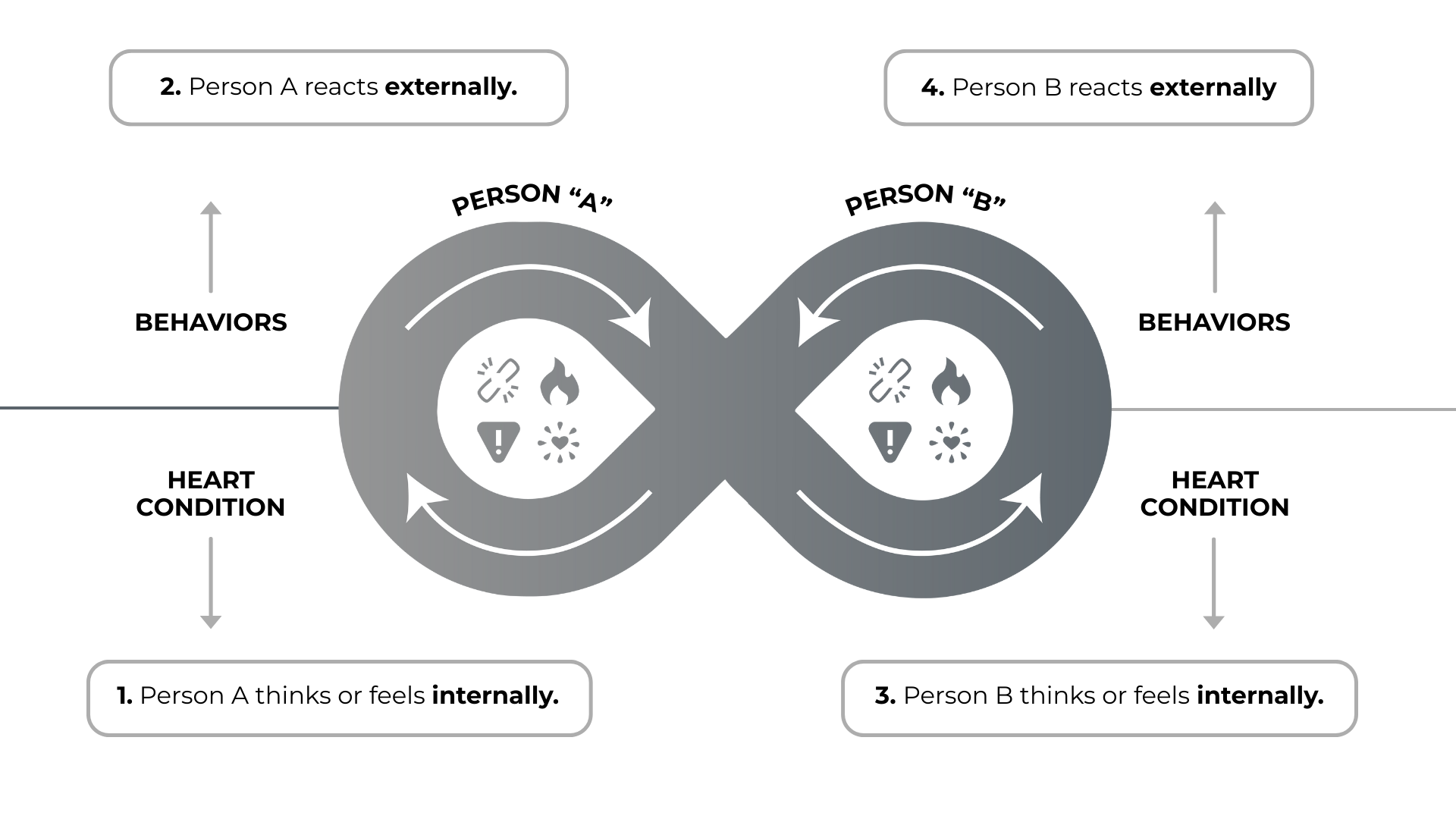
The Dance Diagram (an infinity loop) helps you visualize what’s really happening beneath the surface in any relationship—whether with a spouse, friend, co-worker, or family member. It shows how each person’s reactions are shaped by their Core Motivations—their Core Fear, Desire, Weakness, and Longing.
We all see life through our unique lens, interpreting and reacting based on how aligned (healthy) or misaligned (unhealthy) we are in the moment.
In the diagram:
- Below the line is what’s happening internally—your thoughts, emotions, and Core Motivations (unseen by the other person).
- Above the line is what’s happening externally—your words, tone, and behavior (what the other person does see).
When we don’t consider the hidden motivations below the surface, we often misjudge behaviors and miss what’s really going on. That’s when disconnection happens.
Here’s how The Dance flows:
- Person A thinks or feels internally
- Person A reacts externally
- Person B thinks or feels internally
- Person B reacts externally
🌀 And the cycle continues—until someone becomes aware, pauses, and chooses a healthier response. That’s where real connection begins.
Understanding this cycle gives you a practical way to name what’s really happening in moments of tension, and to respond with empathy, clarity, and compassion instead of reactivity or assumption. This is how you begin to create meaningful change in every relationship.
Here are examples of a misaligned dance for Type 1 and Type 3:

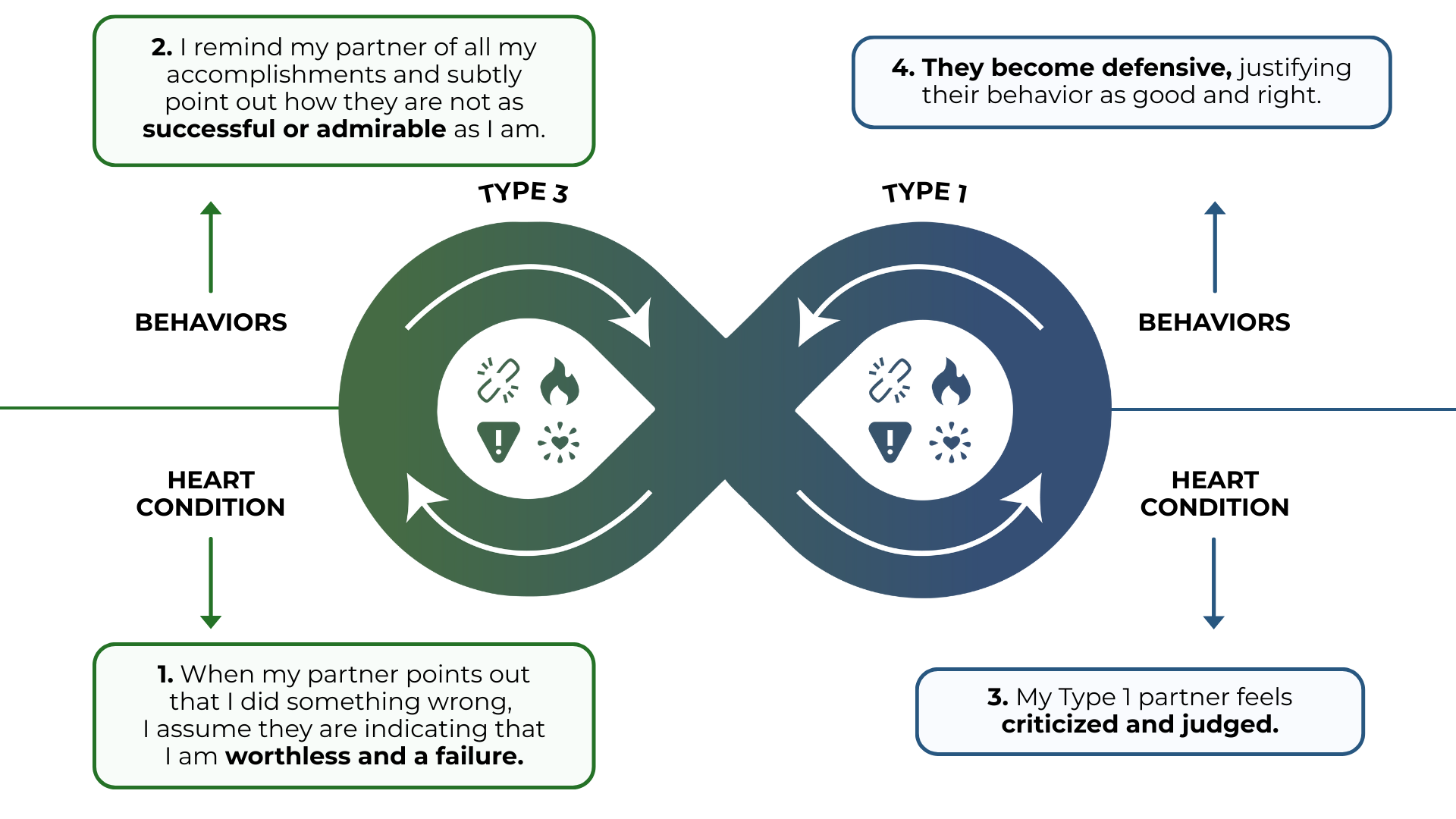
When we’re misaligned, we often engage in a relational dance driven by fear, unmet desires, and unconscious attempts to get our core needs met—usually by expecting our partner to do what only inner growth can provide. This can lead to frustration, disconnection, or even resentment.
But when we become more aligned with who we are and grow in self-awareness, the dynamic shifts. Here are examples of an aligned dance for Type 1 and Type 3:

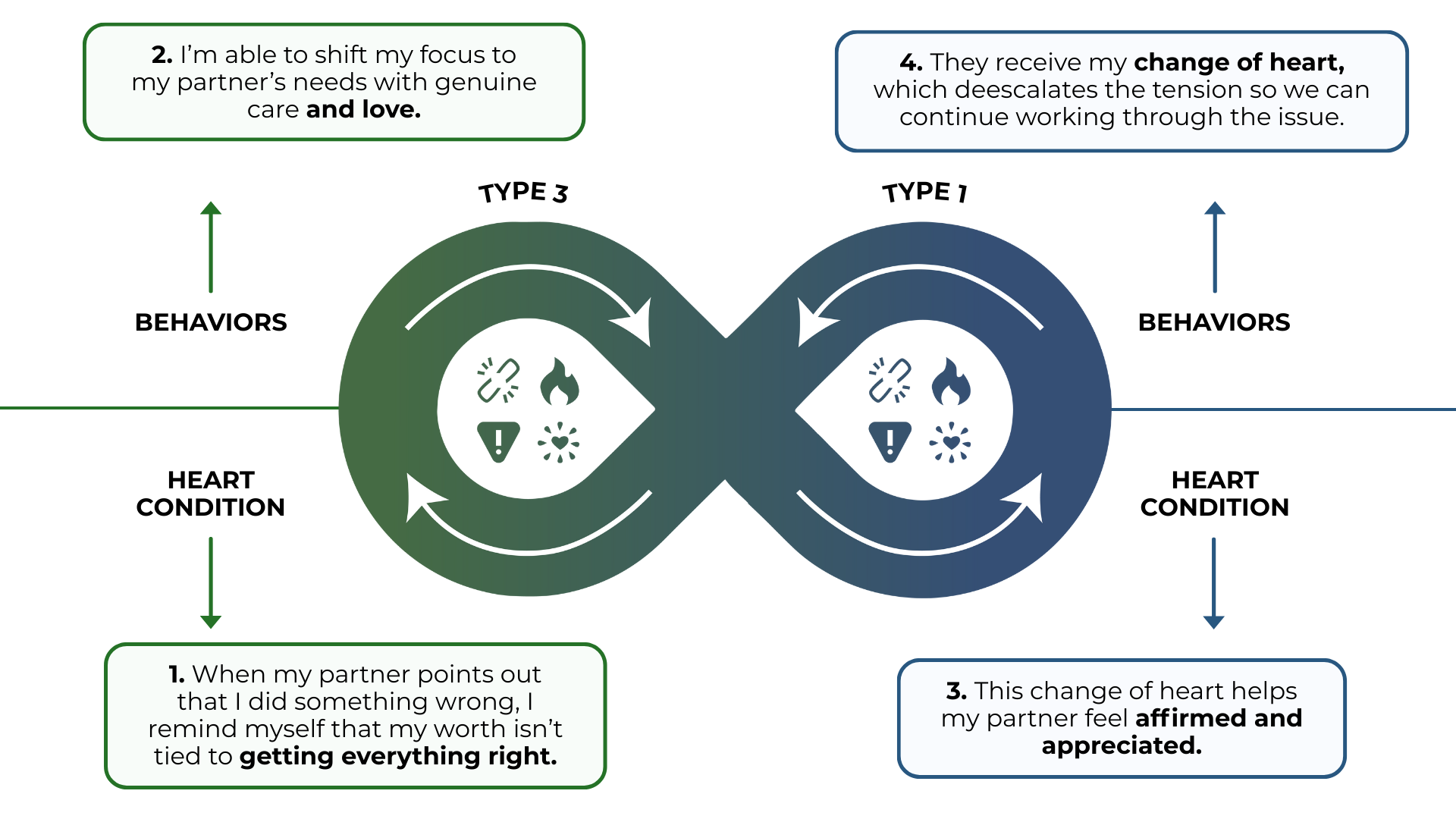
When we are aligned, we begin to recognize our Core Motivations in real time and stop placing the full weight of them on our partner. Instead, we show up with curiosity, grace, and a deeper understanding of what we (and our partner) truly need—creating space for a more balanced, supportive, and connected relationship.
Want to learn more about the dance and how it can help your relationship thrive? Explore our type-specific couple courses—designed to help you grow together with more clarity and connection. Click the link at the bottom of the page to get started!
The Strengths of a Type 1 + Type 3 Relationship 💪
- Shared Drive: Both are hard-working and value growth, creating a motivated and productive partnership.
- Purpose Meets Progress: Type 1 keeps the couple aligned with core values, while Type 3 keeps momentum going.
- Mutual Admiration: Type 1 admires 3’s energy and efficiency; Type 3 appreciates 1’s integrity and commitment.
- Supportive Teamwork: When aligned, they help each other stay focused, grounded, and goal-oriented.
Together, they can build a high-functioning, impact-driven relationship that values both ethical grounding and achievement.
The Challenges of a Type 1 + Type 3 Relationship 💔
Even though this couple shares a love of excellence, friction can arise when their values clash:
- Different Motivations: Type 1 wants to be good, while Type 3 wants to be admired. This can create confusion and unmet emotional needs.
- Pressure to Perform: Both may feel pressure to appear “perfect,” leading to burnout or emotional distance.
- Struggles with Vulnerability: Type 3 may hide insecurities, while Type 1 may struggle to express softer emotions.
- Criticism vs. Image: Type 1 may unintentionally criticize what Type 3 sees as an accomplishment, while Type 3 may gloss over what Type 1 sees as important.
If these differences aren’t addressed with care, the relationship can start to feel more like a performance than a place of connection.
How Their Core Struggles Affect the Relationship ⚠️
Perfectionism and a deep desire for achievement can create friction if unchecked.
This can result in:
- Type 1 feeling frustrated or disillusioned.
They may interpret Type 3’s adaptability or image-consciousness as inauthentic or lacking integrity. - Type 3 feeling unseen or underappreciated.
When their drive and accomplishments aren’t recognized, they may feel like nothing they do is ever “good enough.” - Both feeling judged or misunderstood.
Despite caring deeply, their differences in motivation and expression can leave them disconnected.
Over time, this can lead to resentment. Without honest communication, Type 1 may become more rigid or critical, while Type 3 may disengage emotionally or overwork in an attempt to prove their worth.
Breaking the Cycle ♾️: Shifting from Unconscious Habits to Intentional Connection
The good news? A Type 1 + Type 3 relationship can thrive when both partners honor each other’s values and pace.
- Recognize Effort and Intentions: Type 3 lights up when their hard work is seen, and Type 1 appreciates when their integrity is acknowledged. Taking time to affirm each other’s efforts goes a long way.
- Loosen the Grip on Perfection: Type 1 can practice letting go of unrealistic standards, while Type 3 can release the pressure to constantly achieve. This opens the door to more authentic connection.
- Communicate Honestly and Respectfully: Type 1 can name emotions instead of relying on critique, and Type 3 can express their deeper fears and insecurities—not just their wins. Real connection comes from what’s real.
- Celebrate Progress, Not Just Outcomes: Both types are growth-oriented, but slowing down to notice small wins and shared values helps them stay aligned and encouraged.
By embracing these shifts, a Type 1 + Type 3 couple can build a relationship that blends purpose with possibility—rooted in mutual respect, honesty, and admiration.
The Role of Communication in Building a Stronger Bond 💬
Good intentions can still lead to misunderstanding. Here’s how to stay connected:
- Speak Without Spin: Type 3 should share feelings directly—not just what sounds good.
Type 1 should try to listen without immediately evaluating. Honest expression builds trust, even if it feels vulnerable at first. - Acknowledge Each Other’s Efforts: Type 1’s thoughtful choices and Type 3’s ambitious work both deserve recognition. A simple “I see what you did there” can go a long way in helping both feel valued.
- Don’t Skip the Heart Stuff: Make time for emotional check-ins that go beyond logistics or goals. It reminds each partner that the relationship is more than just a to-do list—it’s a connection worth nurturing.
How Growth and Self-Awareness Strengthen the Relationship 🌱
- Celebrate Small Wins: Type 1 can practice recognizing progress, not just perfection. Type 3 can learn to slow down and enjoy the moment.
- Prioritize Honesty Over Image: Type 3 grows by being emotionally honest, and Type 1 grows by receiving that honesty with grace.
- Make Room for Rest: They both need to learn that worth isn’t based on achievement—rest and connection matter too.
- Encourage Realness: Instead of pushing for outcomes, encourage showing up as you are—mess and all.
Final Thoughts: A Love that Balances Doing and Being 💗
At their best, a Type 1 + Type 3 relationship can blend integrity with ambition—grounded in shared purpose and energized by mutual goals. They thrive when they let go of perfection and performance, creating space to show up authentically and love each other for who they are, not just what they achieve.
What’s next:
If you’re ready to grow closer and finally understand the unique dynamics of your relationship, the Becoming Us course is your next best step. This personalized experience is tailored to your exact Enneagram Type pairing, walking you through eight transformational modules and a beautifully designed 64-page guidebook that reveals how your personalities dance together—both when you're aligned and when you're misaligned.
You'll discover the deeper reasons behind your patterns, gain language to navigate conflict with compassion, and find the clarity and direction you’ve been craving. Couples say they finally feel seen, understood, and equipped—and we know you will too. Your relationship is worth investing in. Take advantage of the special sale and start your Becoming Us journey today. Click here to learn more. 💛
Other Great Next Steps:
|
Get astonishing clarity with your couple-type Becoming Us course |
|
We would love to share some free Enneagram resources with you.